
Discover why refer for complex skin conditions is crucial for patient outcomes. Get essential tools and criteria for effective referrals.

Referring patients with complex skin conditions to a dermatologist is the single most effective way to prevent misdiagnosis, treatment failure, and life-threatening complications that primary care settings are not equipped to manage alone. The decision to refer, and when to make it, defines patient outcomes across conditions ranging from severe atopic eczema to suspected melanoma. This guide gives medical professionals concrete referral criteria, diagnostic frameworks, and practical tools to make that call with confidence. Named resources including the ABCDE criteria, the Rule of Three framework, and AI triage tools like DERM are covered in full.
Why refer for complex skin conditions: the clinical case
Referral for complex skin conditions is not a fallback. It is a clinical skill. Primary care clinicians’ core skill is recognizing when a skin condition exceeds outpatient management, particularly when systemic involvement is present. Waiting for certainty before referring often costs patients weeks of inappropriate treatment and, in the worst cases, irreversible harm.
Complex dermatological cases include conditions that are diagnostically ambiguous, unresponsive to standard therapy, or showing signs of systemic spread. Severe psoriasis, recalcitrant eczema, suspected skin cancer, and dermatologic emergencies like Stevens-Johnson syndrome all fall into this category. These are not conditions where watchful waiting is safe. The benefits of skin referrals in these scenarios include access to dermoscopy, biopsy, systemic therapy, and specialist diagnostic interpretation that primary care simply cannot replicate.

Understanding skin condition referrals also means recognizing the cost of delay. Missed or late diagnoses of melanoma, pemphigus vulgaris, or toxic epidermal necrolysis carry serious morbidity. Specialist care for skin conditions at the right moment changes the trajectory of these diseases entirely.
What clinical signs indicate the need to refer patients?
Certain presentations demand immediate action. Generalized erythema covering more than 90% of body surface area with systemic instability, rashes accompanied by fever, hypotension, or rapid progression are dermatologic emergencies requiring hospital admission, not outpatient review. These are not edge cases. They are the presentations where delayed referral directly increases mortality risk.
Beyond emergencies, the following red flags signal the need for specialist involvement:
- Diagnostic uncertainty or atypical presentation: A lesion that does not fit a clear clinical pattern warrants dermoscopy and specialist assessment, not empirical treatment.
- Failure to respond to optimized therapy: Referral within 2 weeks is recommended for severe eczema unresponsive to consistent topical treatment. One week of failure under optimized therapy is the threshold.
- Changing or suspicious lesions: Red flags for direct referral include changing moles, nonhealing lesions, and chronic conditions unresponsive to treatment. The ABCDE criteria (Asymmetry, Border, Color, Diameter, Evolution) and the weighted 7-point checklist for skin cancer provide structured frameworks for evaluating these lesions.
- Mucosal involvement: Blistering or erosions affecting the mouth, eyes, or genitals alongside skin changes suggest autoimmune bullous disease and require urgent dermatology review.
- Systemic signs in any skin condition: Fever, lymphadenopathy, or organ dysfunction alongside a skin rash shifts the differential toward conditions like drug reaction with eosinophilia and systemic symptoms (DRESS), which carry mortality rates above 10%.
Pro Tip: When documenting a referral for a suspicious lesion, photograph the lesion with a ruler in frame and note the date of first presentation. This single step dramatically improves triage accuracy at the receiving end.
The role of dermatologists in skin cancer management begins at the referral stage. Getting the referral right, with the right urgency level, determines how quickly a patient accesses biopsy and staging.
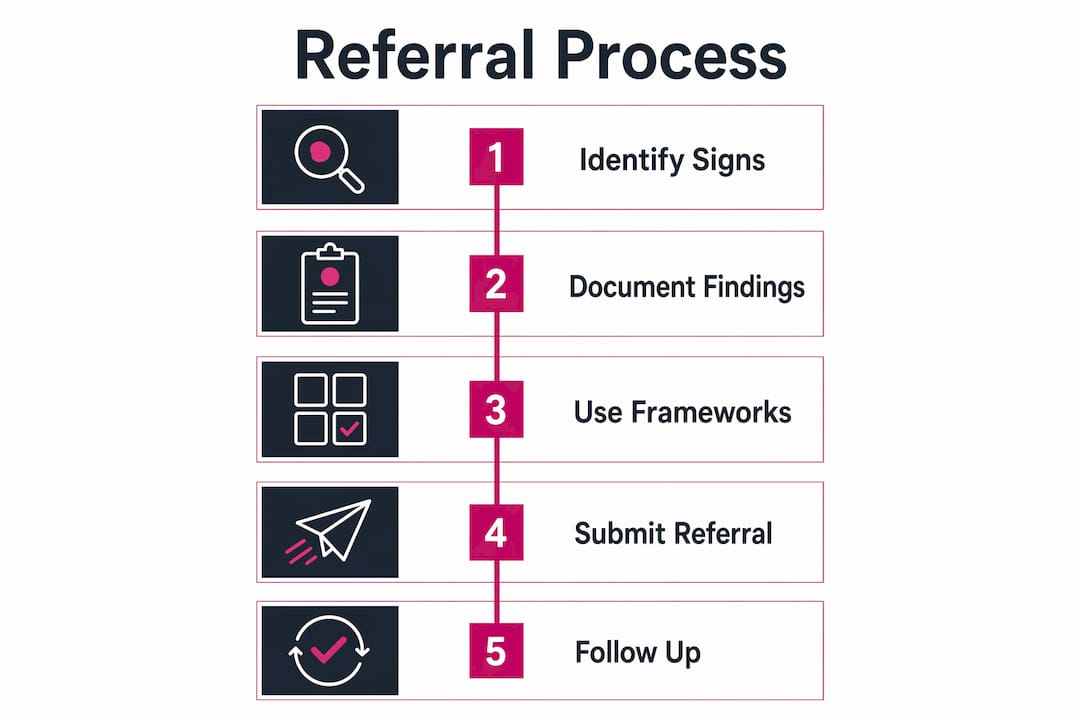
How do diagnostic frameworks like the Rule of Three support referral decisions?
The Rule of Three is a morphology-based diagnostic framework designed for primary care settings. It categorizes skin conditions into inflammatory, infectious, or neoplastic, then asks the clinician to identify three diagnoses: the most likely, the common mimic, and the must-not-miss condition. This structure prevents the cognitive shortcut of anchoring on a single diagnosis and missing a dangerous alternative.
The “must-not-miss” column is where referral decisions live. If the must-not-miss diagnosis for a given presentation is melanoma, pemphigus, or cutaneous T-cell lymphoma, that uncertainty alone justifies specialist referral. Implementing this prioritized framework reduces cognitive overload in busy primary care settings and supports timely, safe referral decisions.
“The Rule of Three does not replace clinical judgment. It organizes it. In a 10-minute consultation, having a mental scaffold that forces you to name the must-not-miss diagnosis is what separates a safe clinician from a fast one.”
The table below maps common presentations to the Rule of Three categories and their referral implications:
| Presentation | Most likely diagnosis | Must-not-miss | Referral urgency |
|---|---|---|---|
| Asymmetric pigmented lesion | Seborrheic keratosis | Melanoma | Urgent (2-week pathway) |
| Chronic pruritic rash, treatment-resistant | Atopic eczema | Cutaneous T-cell lymphoma | Soon (within 2 weeks) |
| Blistering with mucosal erosions | Bullous pemphigoid | Pemphigus vulgaris | Urgent |
| Widespread erythema with systemic signs | Drug reaction (DRESS) | Toxic epidermal necrolysis | Emergency admission |
| Nonhealing ulcer on sun-exposed skin | Basal cell carcinoma | Squamous cell carcinoma | Urgent (2-week pathway) |
Referral pathways in the UK’s NHS, including the urgent suspected cancer pathway, are built around this kind of structured clinical reasoning. The same logic applies in U.S. practice: diagnostic certainty directly determines referral urgency, and structured frameworks make that certainty explicit rather than implicit.
What role do teledermatology and AI play in optimizing referrals?
Teledermatology and AI triage tools are changing the economics of dermatology referrals. About 60% of dermatology referrals in the NHS concern suspected skin cancer, yet only 6% of those referrals confirm cancer. That ratio represents enormous system strain and patient anxiety. AI tools and teledermatology platforms are now being deployed specifically to close that gap.
AI technologies like DERM provide lesion classification and referral recommendations, helping identify suspicious lesions that need specialist review while filtering out benign cases that do not. DERM uses convolutional neural networks trained on large dermoscopic image datasets to distinguish between lesion types with accuracy that rivals experienced dermatologists in controlled studies. For primary care clinicians without dermoscopy training, this represents a meaningful clinical support tool.
Teledermatology extends this further by enabling store-and-forward image review by a dermatologist, often within 24 to 72 hours. For patients in rural or underserved areas, this replaces a 6-week wait for an in-person appointment with a rapid specialist opinion that either confirms the need for an urgent visit or safely discharges the patient. Learn more about teledermatology’s clinical applications and how they fit into modern referral workflows.
Pro Tip: When using a teledermatology platform, submit at least three images per lesion: one close-up, one with surrounding skin context, and one with a ruler or coin for scale. Single-image submissions are the most common reason for inconclusive remote assessments.
The limitations of these tools are real. AI performs poorly on lesions with poor image quality, unusual anatomical locations, or rare morphologies not well-represented in training data. Teledermatology cannot replace palpation, and it cannot assess lesion firmness, depth, or texture. These tools support referral decisions. They do not replace the clinical judgment that triggers them.
How technology is reshaping dermatology continues to evolve rapidly, and staying current with these tools is now part of competent primary care practice.
What are best practices for managing dermatology referrals?
A well-structured referral is not a formality. It is a clinical communication that determines how quickly and accurately a specialist can act. Providing detailed clinical information, treatment history, and clear questions in referrals improves care coordination and triage prioritization at the receiving practice.
The following practices consistently improve referral quality:
- State the clinical question explicitly. “Please assess this lesion for malignancy” is more useful than “please review rash.” Specialists triage based on the stated concern, not the implied one.
- Include full treatment history. Document every topical or systemic therapy tried, the duration, the dose, and the patient’s response. A dermatologist who does not know that a patient has already failed two courses of potent topical steroids will repeat that step.
- Describe the lesion precisely. Use standard dermatologic terminology: morphology (macule, papule, plaque), distribution, color, border characteristics, and any secondary changes such as scaling, crusting, or excoriation.
- Attach clinical photographs. Even smartphone images taken in good lighting improve specialist triage accuracy and reduce the likelihood of a patient being downgraded to a routine appointment when urgent review is warranted.
- Flag systemic involvement clearly. If the patient has fever, weight loss, lymphadenopathy, or mucosal involvement, this must appear in the first line of the referral, not buried in the history.
Using a dermatology referral checklist standardizes this process across a practice and reduces the rate of incomplete referrals that get returned or deprioritized.
Key takeaways
Referring patients with complex skin conditions at the right time, with the right documentation, is the most direct lever primary care clinicians have over patient outcomes in dermatology.
| Point | Details |
|---|---|
| Refer on red flags, not certainty | Systemic signs, mucosal involvement, or diagnostic uncertainty justify referral before a diagnosis is confirmed. |
| Use the Rule of Three | Naming the must-not-miss diagnosis in every complex case forces the referral question into the open. |
| Apply structured criteria | ABCDE criteria and the weighted 7-point checklist provide objective thresholds for urgent skin cancer referrals. |
| Leverage AI and teledermatology | Tools like DERM and store-and-forward platforms reduce unnecessary referrals and accelerate triage for suspicious lesions. |
| Document with precision | Detailed referrals with photographs, treatment history, and a clear clinical question improve specialist response time and care quality. |
What I’ve learned from years of watching referral decisions go wrong
The most common referral failure I see is not under-referring. It is referring too late with too little information. A clinician watches a lesion for three months, tries two treatments, and then sends a one-line referral with no photograph and no treatment history. By the time the patient reaches a specialist, the clinical picture has changed, the treatment record is incomplete, and the specialist is starting from scratch.
The second failure is the opposite: over-referring benign conditions without applying any structured criteria first. This clogs urgent pathways and delays genuinely high-risk patients. The weighted 7-point checklist and ABCDE criteria exist precisely to prevent this. They are not bureaucratic tools. They are clinical filters that protect the patients who need urgent access most.
What I find most encouraging about the current moment in dermatology is the combination of structured frameworks and technology. The Rule of Three gives clinicians a mental scaffold. AI tools like DERM give them an objective second opinion on lesion morphology. Teledermatology gives them rapid specialist access without a 6-week wait. None of these tools work in isolation, but together they make the referral decision more defensible, more timely, and more accurate than it has ever been.
My advice to any primary care clinician reading this: treat the referral decision as a clinical skill you can improve, not a threshold you either hit or miss. The frameworks exist. Use them consistently, document thoroughly, and refer early when the must-not-miss diagnosis is on the table.
— Krunal
Expert dermatology referral support at Raodermatology
When a complex skin condition exceeds what primary care can safely manage, your patients deserve specialist evaluation from a practice with the depth to act on it.
Raodermatology, founded by Dr. Babar K. Rao with over 25 years of experience across California, New Jersey, and New York, offers referring clinicians direct access to specialized dermatology services covering medical dermatology, skin cancer detection and treatment, and expert dermatopathology. For cases involving suspicious lesions or potential malignancy, Raodermatology’s skin cancer diagnosis and treatment pathway provides rapid evaluation with the diagnostic precision that complex cases require. Contact Raodermatology to discuss referral pathways and get your patients seen by the right specialist at the right time.
FAQ
When should a primary care physician refer a skin condition?
Refer when a skin condition shows systemic signs such as fever or mucosal involvement, fails to respond to optimized therapy within one to two weeks, or presents with diagnostic uncertainty including any lesion that could be malignant.
What is the ABCDE criteria used for in dermatology referrals?
The ABCDE criteria (Asymmetry, Border, Color, Diameter, Evolution) provide a structured checklist for evaluating pigmented lesions and determining whether urgent referral for suspected melanoma is warranted.
How does the Rule of Three help with referral decisions?
The Rule of Three organizes clinical assessment into the most likely diagnosis, common mimics, and must-not-miss conditions, making the referral question explicit whenever a dangerous diagnosis cannot be excluded.
What is teledermatology and how does it support referrals?
Teledermatology uses store-and-forward image review by a dermatologist to provide rapid specialist opinions, often within 24 to 72 hours, reducing unnecessary in-person referrals and accelerating triage for high-risk lesions.
What information should a dermatology referral always include?
Every referral should include a precise lesion description, full treatment history with response, clinical photographs, and a clearly stated clinical question to allow the specialist to triage accurately and act without delay.
Recommended
Filed under: