
Discover what is teledermatology in our 2026 guide. Learn how it works, its accuracy, and when to seek in-person care for skin issues.
Wondering what teledermatology actually means, and whether it can replace your next trip to the dermatologist? You are not alone. Millions of patients are turning to telemedicine for skin issues without fully understanding what these services offer, how accurate they are, or when a video call simply cannot do the job. This guide cuts through the confusion. You will learn exactly what teledermatology is, how the two main models work, where the technology shines, and where it has real limits — so you can make a genuinely informed decision about your skin care.
Table of Contents
- Key Takeaways
- What is teledermatology and how it works
- Diagnostic accuracy: how effective is teledermatology?
- Comparing teledermatology models and platforms
- Practical applications: when teledermatology helps most
- Limitations patients should understand
- My honest take on remote skin care
- Get expert skin care from Raodermatology
- FAQ
Key Takeaways
| Point | Details |
|---|---|
| Two core models exist | Store-and-forward and live video are the primary formats, each suited to different clinical needs. |
| Diagnostic accuracy is solid but not perfect | Overall diagnostic concordance reaches 76%, improving with dermoscopy for skin cancer cases. |
| Wait times drop dramatically | Tele-triage can reduce dermatology appointment wait times from 51 days to just 8 days. |
| Photo quality matters enormously | Only about 55% of patient-submitted photos meet clinical standards, making image preparation critical. |
| It complements, not replaces, in-person care | Teledermatology is best used alongside traditional visits, not as a permanent substitute. |
What is teledermatology and how it works
Teledermatology is the practice of delivering dermatological care remotely using digital technology. A patient submits photographs of a skin condition, or connects with a board-certified dermatologist over a live video call, and receives a diagnosis, a management plan, or a referral. The concept falls under the broader umbrella of telemedicine for skin issues, and it has grown significantly as patients seek faster, more accessible care.
There are two primary models you will encounter.
Store-and-forward (asynchronous): The patient or a referring physician captures images of the skin condition and uploads them alongside a clinical history. The dermatologist reviews the case at a later time, typically within 24 to 72 hours, and responds with findings. This model is the most widely used format, and it works especially well for triage and routine evaluations.
Live interactive video (synchronous): The patient and dermatologist connect in real time over a secure video platform. This format works well for follow-up appointments, patient education, and cases where real-time dialogue helps clarify symptoms or treatment progress.
Here is what a typical teledermatology encounter looks like for most patients:
- You notice a suspicious mole, rash, or change in your skin.
- You book an appointment through a teledermatology platform or your existing provider.
- You submit clear, well-lit photographs along with a description of your symptoms and medical history.
- A dermatologist reviews your case and contacts you with a diagnosis, prescription if appropriate, or a referral for an in-person visit.
Pro Tip: Before your teledermatology session, take photos in natural daylight rather than under fluorescent or dim lighting. Natural light captures true skin tone and texture far more accurately, which directly affects the quality of the diagnosis you receive.
Diagnostic accuracy: how effective is teledermatology?
One of the most common questions patients ask is, “Is teledermatology effective?” The short answer is yes, with important caveats. The clinical evidence shows that teledermatology achieves 76% diagnostic concordance with in-person consultations. For skin cancer specifically, concordance sits at 73%, but using dermoscopy (a magnified imaging technique) pushes that accuracy up to 80%.
Those numbers are meaningful. A 76% agreement rate means that in roughly three out of four cases, a teledermatology assessment reaches the same conclusion as a face-to-face examination. That is clinically significant, particularly for common, clearly visible conditions like eczema, psoriasis, acne, and rosacea.
Where does it perform best? Teledermatology suits triage and chronic disease monitoring particularly well. Monitoring a patient’s psoriasis flare over time or triaging whether a concerning mole needs urgent biopsy are both areas where remote assessment adds real value.
| Condition type | Teledermatology suitability | Notes |
|---|---|---|
| Common inflammatory conditions (acne, eczema, psoriasis) | High | Visually distinct patterns; responds well to image review |
| Pigmented lesions / skin cancer screening | Moderate to high | Dermoscopy improves accuracy significantly |
| Conditions requiring physical palpation | Low | Texture and firmness cannot be assessed remotely |
| Wound assessment or post-procedure follow-up | Moderate | Image quality and patient compliance are critical |
Patient satisfaction data tells a similar story. 82% of patients report satisfaction with teledermatology services. Yet only about 26.57% say they would fully replace all their in-person dermatology visits with virtual ones. Patients appreciate the convenience, but most still value the reassurance of a physical examination for complex or serious concerns.
Pro Tip: If you are monitoring a skin condition over time, photograph it from the same angle and distance at every session. Consistent documentation allows your dermatologist to track changes accurately rather than comparing incompatible images.
Comparing teledermatology models and platforms
Understanding the difference between the two models helps you choose the right option for your situation. The store-and-forward model has a clear operational advantage: it does not require you and the dermatologist to be available at the same time. You submit your case, and the physician reviews it when they can. This flexibility makes it ideal for busy patients and for practices managing high patient volumes.
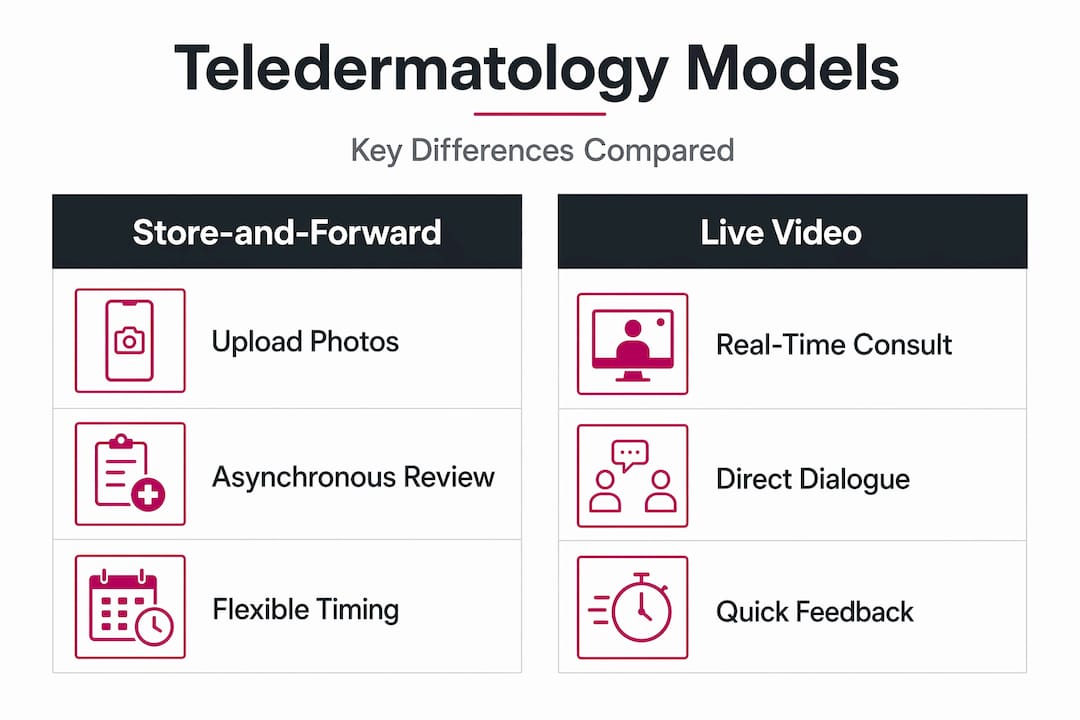
The live video model, by contrast, functions more like a traditional appointment. You schedule a time, connect over a secure link, and speak directly with the dermatologist. This format works well for follow-up visits after a diagnosis has already been made, for patients who need to walk through a treatment plan in detail, or for cases involving anxiety where direct communication makes a difference.
Both models come with real technology requirements worth considering:
- High-resolution photographs with clear focus and consistent lighting
- A stable internet connection for live video sessions
- Patient familiarity with smartphone cameras or telehealth apps
- HIPAA-compliant platforms to protect your health information
One challenge that often goes unaddressed is photo quality. Only about 55.1% of patient-submitted photographs actually meet the clinical quality standards needed for accurate diagnosis. Blurry images, poor lighting, and inconsistent angles all reduce the diagnostic value of a submission. This is not a minor issue. It directly affects the quality of care you receive.
Older patients face an additional barrier. Research consistently shows that older patients prefer in-person visits even when teledermatology is available, reflecting genuine comfort and trust challenges with digital tools. Good teledermatology providers account for this by offering patient coaching and technical support before consultations. You can also read more about how technology is reshaping dermatology to understand where the field is heading.
Practical applications: when teledermatology helps most
The benefits of teledermatology become clearest when you look at specific patient scenarios. Here are the situations where remote care genuinely delivers:
-
Rural and underserved communities. Patients in areas without nearby dermatologists no longer have to drive hours for a consultation. Teledermatology closes that geographic gap directly.
-
Managing chronic skin conditions. Patients with psoriasis, eczema, or rosacea benefit from regular monitoring without the burden of frequent in-office visits. Routine check-ins can happen remotely, reserving in-person appointments for flare-ups requiring hands-on assessment.
-
Urgent triage for suspicious lesions. This is where the speed advantage becomes critical. Teledermatology can reduce wait times from 51 days to 8 days through triage models, meaning a worrying mole gets evaluated in days rather than weeks.
-
Post-treatment follow-up. After a procedure or prescription, a quick image submission or video check-in confirms whether treatment is working without requiring a full clinic visit.
-
Education for primary care providers. This benefit often surprises people. 93% of primary care providers report improved dermatology management after using store-and-forward teledermatology, because the feedback from dermatologists teaches them to recognize and manage conditions they previously referred automatically.
Pro Tip: If you are using teledermatology to triage a suspicious mole or lesion, do not wait. Submit your case as soon as you notice the change. Earlier triage means earlier diagnosis, which is especially critical for skin cancer outcomes.
Limitations patients should understand
Teledermatology has real strengths, but expecting it to handle everything would be a mistake. Knowing where it falls short protects you as a patient.
- Physical examination cannot be replicated. Dermatologists assess texture, firmness, and tenderness during in-person visits. Teledermatology cannot address tactile assessment, which means conditions like certain nodules, cysts, or infections with physical characteristics require in-person evaluation.
- Biopsies and procedures require a clinic visit. If a suspicious lesion needs to be removed or sampled, that step cannot happen remotely. Teledermatology can flag the need for a biopsy, but it cannot perform one.
- Image quality is the patient’s responsibility. Most platforms depend on you to submit usable photos. Poor lighting, motion blur, or incomplete coverage of the affected area can lead to inconclusive results.
- Privacy and legal considerations exist. Make sure any platform you use is HIPAA-compliant and that you understand how your health data and images are stored and shared.
- Technology comfort gaps are real. Managing patient expectations is critical to successful teledermatology adoption, particularly for populations less comfortable with virtual systems.
Teledermatology works best as a first step and a monitoring tool. Think of it as a way to get the right care faster, not as a reason to avoid seeing a dermatologist in person when your condition warrants it.
Reviewing the benefits of seeing a dermatologist in person is worth your time if you are unsure whether remote care is sufficient for your specific situation.
My honest take on remote skin care
I have watched teledermatology grow from a niche triage tool into a genuine part of dermatological practice, and I find myself both enthusiastic and cautious about it in equal measure.
Here is what I think most articles get wrong: they treat teledermatology as either a revolution or a risk. In my experience, it is neither. It is a very good tool used poorly by patients who over-rely on it, and underused by patients who dismiss it entirely because they assume nothing can replace a physical exam.
The patients I see benefiting most are those who use teledermatology to get into the system faster, not to avoid the system altogether. Submitting a photo of a suspicious spot and receiving a callback that says “come in this week” is a genuinely life-changing use of this technology. Using it to avoid addressing a lesion that has been changing for six months is not.
I also think the photo quality problem is dramatically underestimated. Patients submit blurry, poorly lit images and assume the dermatologist can work with them. Often they cannot. Spending two minutes learning to take a clinically useful photo before your consultation changes the entire quality of care you receive.
My advice is straightforward: use teledermatology as an on-ramp to dermatological care, not a replacement for it. Ask your provider openly whether your concern suits a remote consultation or needs a physical visit. A good dermatology practice will tell you honestly which path makes sense for your skin.
— Krunal
Get expert skin care from Raodermatology
Whether you are exploring teledermatology for the first time or looking for board-certified dermatologists with deep experience in both remote and in-person care, Raodermatology serves patients across California, New Jersey, and New York with 25+ years of expertise. The practice offers a full range of dermatology services, from triage consultations and chronic skin condition management to specialized skin cancer detection and treatment. Dr. Babar K. Rao and the team combine advanced diagnostic technology with genuinely personalized care, so you always know whether a virtual consultation or an in-office visit is the right next step for your skin health.
FAQ
What is teledermatology used for?
Teledermatology is used to diagnose and manage skin conditions remotely through image submissions or live video consultations. It works especially well for triage, chronic condition monitoring, and follow-up care.
How accurate is a teledermatology diagnosis?
Teledermatology achieves an overall diagnostic concordance of 76% with in-person care, rising to 80% for skin cancer cases when dermoscopy is used. Accuracy depends heavily on image quality and the complexity of the condition.
Is teledermatology effective for skin cancer?
Teledermatology can effectively triage suspicious lesions and flag cases requiring urgent biopsy, reducing wait times significantly. However, any confirmed or suspected skin cancer will still require an in-person visit for biopsy and treatment.
What is store-and-forward teledermatology?
Store-and-forward teledermatology involves submitting photos and medical history for a dermatologist to review asynchronously. Turnaround time is typically 24 to 72 hours, making it the most common teledermatology model in practice.
Does teledermatology replace in-person dermatology visits?
No. Only about 26.57% of patients are willing to fully replace in-person visits with virtual ones. Teledermatology works best as a complement to traditional care, particularly for triage and ongoing monitoring.
Recommended
- How technology is reshaping dermatology for better skin care | Rao Dermatology
- How to refer dermatology patients efficiently and well | Rao Dermatology
- Medical dermatology: Your guide to diagnosis and treatment | Rao Dermatology
- Your dermatologist visit, step by step: a patient guide | Rao Dermatology
Filed under: