
Discover the crucial role of dermatologists in skin cancer prevention, detection, and treatment. Book your appointment today for personalized care!
Most people glance at a new spot on their skin and talk themselves out of doing anything about it. It looks small. It’s probably nothing. Booking an appointment feels like an overreaction. But this hesitation is exactly how skin cancer advances quietly. The role of dermatologists in skin cancer care starts far earlier than most patients realize, covering prevention, early detection, precise diagnosis, and treatment, all under one specialist’s roof. Waiting to see a dermatologist is never wasted time, even when a spot turns out to be benign, because that visit builds your risk profile and personalizes your care plan.
Table of Contents
- How dermatologists detect skin cancer: evaluation and biopsy
- Recognizing when to see a dermatologist: the ABCDE guide and more
- How dermatologists confirm diagnosis and guide treatment planning
- Skin cancer prevention and long-term care with dermatologists
- Why trusting dermatologists early transforms skin cancer outcomes
- Partner with experienced dermatologists for skin cancer care
- Frequently asked questions
How dermatologists detect skin cancer: evaluation and biopsy
To understand why dermatologists are essential in skin cancer care, start with how they find it in the first place. It is not just a visual once-over. The process is systematic, tool-assisted, and much more revealing than a self-check at home.
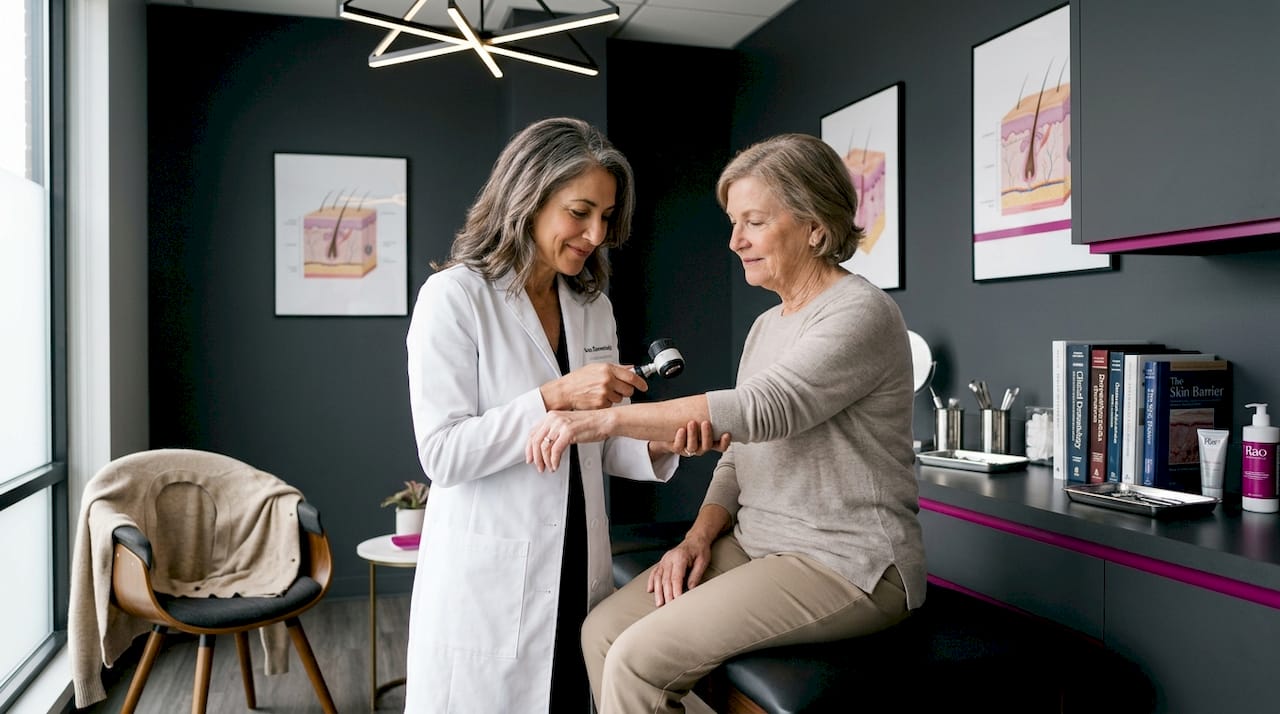
Dermatologists begin with a full-body skin exam, scanning for lesions, discolorations, and textural changes that patients rarely notice themselves. Then they reach for a dermatoscope, a handheld device that illuminates and magnifies the skin’s surface layers. This changes everything diagnostically. Dermoscopy raises melanoma detection sensitivity from 80% to 92.3%, closing the gap between what the naked eye misses and what a biopsy can confirm.
Key things dermatologists evaluate during a skin exam include:
- Asymmetry in a mole’s shape or structure beneath the surface
- Color patterns that vary across a single lesion
- Vascular structures visible only under dermoscopy
- Texture and border changes too subtle for a mirror check
- New or evolving lesions since your last visit
If something looks suspicious, you will not be asked to schedule a second appointment and wait. Biopsies are typically done in-office during the same visit, which compresses the diagnostic timeline significantly. The tissue sample goes directly to a lab, and treatment planning can begin within days rather than weeks.
Pro Tip: Before your appointment, photograph any spots you are monitoring at home. Consistent photos over time help your dermatologist track changes more accurately, especially for lesions that are not immediately concerning but warrant watching. Learn more about what this process involves in our dermatoscopy guide.
Recognizing when to see a dermatologist: the ABCDE guide and more
With a clear understanding of detection tools, it’s vital to know when your skin changes warrant a dermatologist’s attention. The good news is that dermatology has given patients a straightforward framework. The bad news is most people still wait too long to use it.
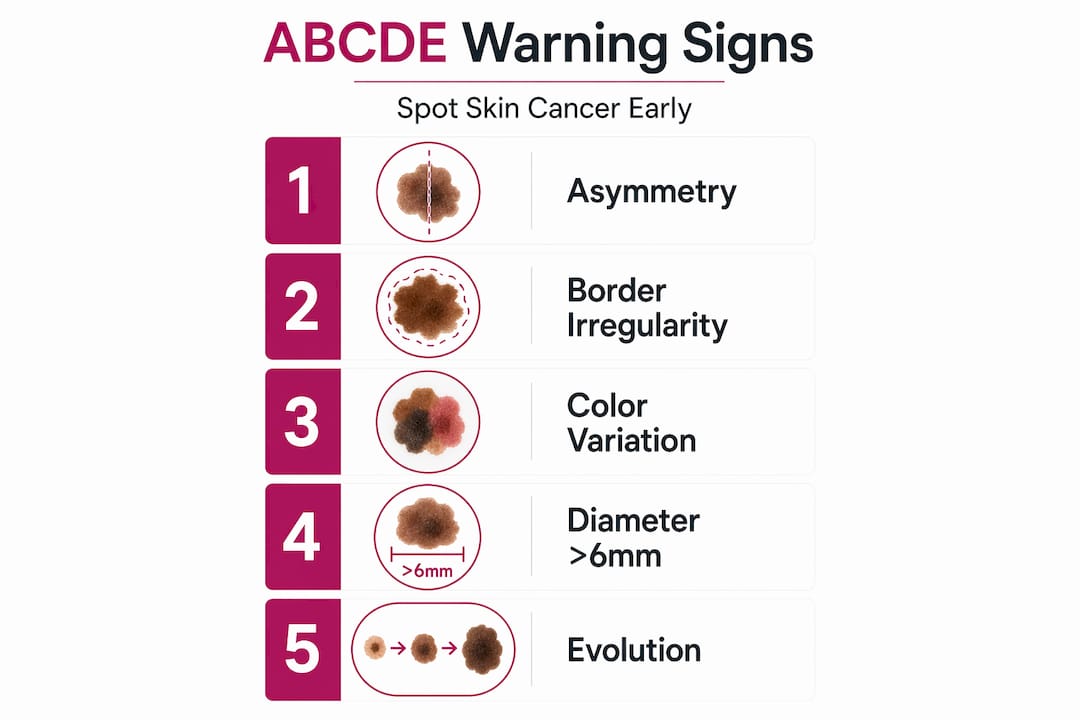
The ABCDE criteria are the most widely used starting point. These five warning signs guide you in recognizing when a mole or spot deserves professional evaluation:
- A: Asymmetry. One half of the spot does not match the other.
- B: Border. Edges are ragged, notched, or blurred rather than smooth.
- C: Color. Multiple shades of brown, black, red, white, or blue within a single spot.
- D: Diameter. Larger than 6 millimeters, roughly the size of a pencil eraser.
- E: Evolution. Any change in size, shape, color, or texture over weeks or months.
These signs point primarily to melanoma, but skin cancer takes other forms too. Basal cell carcinoma and squamous cell carcinoma can appear as persistent sores, scaly patches, or flesh-colored bumps that never quite heal. Bleeding, itching, pain, or a wound that reopens repeatedly are all legitimate reasons to book an appointment, even when the spot does not check the ABCDE boxes.
“I often see patients who held off for months because their spot did not fit the classic description. But skin cancer does not always follow the textbook presentation. When something feels wrong, that instinct is worth a dermatologist’s opinion.”
Pro Tip: Do not limit your self-checks to moles. Skin cancers frequently appear on the scalp, behind the ears, between toes, and under fingernails, places people routinely skip. Review the full ABCDE melanoma criteria and what each sign looks like in practice, and bookmark our early skin cancer detection resource for monthly self-exam guidance.
How dermatologists confirm diagnosis and guide treatment planning
Detection leads to diagnosis, which must be confirmed precisely to guide effective treatment. This is where the role of skin specialists expands beyond what most patients expect, bringing in a second layer of expertise.
After a biopsy, the tissue sample does not go to a general lab. It goes to a dermatopathologist, a physician who has completed both dermatology and pathology training. Dermatopathologists provide microscopic confirmation of the exact tissue changes present, identifying not just whether cancer exists but what type, how deep it has grown, and what its cellular behavior suggests about spread. That level of specificity directly shapes the treatment path your dermatologist recommends. Explore how this process works through our dermatopathology services page.
Here is how treatment planning typically unfolds after a confirmed diagnosis:
- Review pathology results. Your dermatologist receives the full dermatopathology report and explains what the findings mean for your specific cancer type and stage.
- Determine surgical candidacy. Most non-melanoma skin cancers are removed surgically in the office. For cases on the face or cosmetically sensitive areas, Mohs surgery is often the preferred method because it removes cancerous tissue in precise layers while sparing healthy skin.
- Assess depth and spread. Melanoma diagnoses trigger additional staging, which may include imaging to check lymph nodes and nearby tissue.
- Build an oncology referral when needed. Treatment options expand significantly for advanced or metastatic cases, including immunotherapy, targeted therapy, and radiation, coordinated with oncology specialists.
| Cancer type | Common treatment | Typical setting |
|---|---|---|
| Basal cell carcinoma | Surgical excision or Mohs | In-office |
| Squamous cell carcinoma | Excision, Mohs, or radiation | In-office or clinic |
| Melanoma (early stage) | Wide local excision | In-office or surgical center |
| Melanoma (advanced) | Immunotherapy or targeted therapy | Oncology partnership |
Pro Tip: Ask your dermatologist whether your biopsy will be reviewed by a board-certified dermatopathologist. Practices with in-house dermatopathology expertise typically turn around results faster and with greater diagnostic precision than sending samples to general pathology labs.
Skin cancer prevention and long-term care with dermatologists
Beyond diagnosis and treatment, effective skin cancer care depends on prevention and vigilant long-term management. The importance of dermatologists does not end once a lesion is removed. In many ways, that is when ongoing care becomes most critical.

High-risk patients should see a dermatologist annually for surveillance, even when no new spots have appeared. Risk factors that warrant this level of monitoring include a personal or family history of melanoma, a high mole count, a history of sunburns (particularly blistering sunburns in childhood), immunosuppression, and significant cumulative sun exposure, which is especially relevant for patients in sun-heavy states like California.
What consistent dermatology surveillance actually includes:
- Full-body mapping. Photographing and documenting every mole so changes are trackable over time.
- Dermoscopy of existing lesions. Comparing current appearance against baseline images from prior visits.
- New lesion identification. Catching spots that emerged since your last exam before they have time to progress.
- Education updates. Reinforcing sun protection habits, reviewing new topical options, and discussing any changes in risk based on health or lifestyle.
Monthly self-exams combined with yearly professional checks create the most effective safety net available for skin cancer prevention. Neither one alone is sufficient. Self-exams catch changes between appointments. Professional exams catch what self-checks miss entirely.
Pro Tip: Schedule your annual skin cancer screening at the same time each year, ideally after summer if you live in a high-sun-exposure region. Post-summer checks give your dermatologist the best view of cumulative UV damage from the preceding months. You can also read about the broader benefits of dermatology visits to understand what else a routine appointment can catch beyond cancer screening.
Why trusting dermatologists early transforms skin cancer outcomes
Here is an uncomfortable reality in dermatology care: the patients who benefit the most from early dermatologist visits are often the ones most reluctant to schedule them. They feel their concern is not serious enough. They assume the spot is just a new freckle. They tell themselves they will go if it gets worse.
This pattern has real consequences. Not because every spot is dangerous, but because professional exams catch issues earlier than self-checks alone. The dermatologist’s trained eye, paired with dermoscopy and direct access to biopsy tools, creates a clinical safety net that no amount of Googling or mirror-checking can replicate.
The other argument for going early, even for a spot that turns out benign, is that it builds your relationship with a specialist who knows your skin’s baseline. That context is invaluable. When something does change, your dermatologist is not evaluating a stranger’s skin. They are comparing today’s findings against a detailed history they already have on file. That visit is never wasted because it either rules out risk or accelerates the response to it.
For patients in California, New Jersey, and New York, where sun exposure, environmental factors, and busy schedules all converge, waiting for certainty before seeing a dermatologist is a gamble that rarely pays off. Early visits compress the time between suspicion and treatment. That compression is what saves lives in cases where skin cancer was caught at stage one rather than stage three. The benefits of seeing a dermatologist early extend well beyond any single spot.
Partner with experienced dermatologists for skin cancer care
Now that you understand the vital role dermatologists play in skin cancer care, finding expert support is the natural next step.

At Rao Dermatology, our team brings 25+ years of experience in skin cancer prevention, detection, and treatment across California, New Jersey, and New York. Our skin cancer services cover full-body screenings, in-office biopsies, Mohs surgery coordination, and post-treatment surveillance, all in one practice. We also offer coordinated dermatopathology expertise to ensure your biopsy results are analyzed with the precision your diagnosis deserves. Whether you need a first-time screening or ongoing management after a prior diagnosis, explore our full range of dermatology services and take the step that protects your skin long-term.
Frequently asked questions
How often should I see a dermatologist for skin cancer screening?
If you are at high risk of skin cancer, yearly dermatologist visits are recommended even when no new skin changes have appeared; average-risk individuals should combine annual professional checks with monthly self-exams.
What are the ABCDE warning signs to watch for on my skin?
The ABCDE signs stand for Asymmetry, Border irregularity, Color variation, Diameter over 6 millimeters, and Evolution, meaning any noticeable change in a mole or spot over time.
Can dermatologists perform biopsies during my initial visit?
Yes. Biopsies are often done in-office at the same appointment as your skin exam, which speeds up the path from suspicion to confirmed diagnosis and treatment planning.
What is the difference between a dermatologist and a dermatopathologist?
Dermatologists examine patients, identify suspicious lesions, and perform biopsies, while dermatopathologists analyze skin samples under a microscope to confirm the exact diagnosis and guide the treatment plan.
What treatments do dermatologists offer if skin cancer is found?
Many skin cancers are treated surgically by dermatologists in-office, while more complex or advanced cases may require oncology-based treatments such as immunotherapy or radiation.
Recommended
- What Is Dermatoscopy? Guide to Early Skin Cancer Detection | Rao Dermatology
- A patient’s guide to lasers in dermatology | Rao Dermatology
- Skin cancer screening: early detection and prevention | Rao Dermatology
- Annual Skin Cancer Screening: Your Complete Guide to Dermatology Checkups | Rao Dermatology
Filed under: