
Discover what Mohs surgery is and why it's the gold standard for skin cancer treatment. Read our guide for insights on benefits, safety, and recovery!

If you’ve recently been diagnosed with skin cancer, you’ve probably heard several treatment options mentioned in quick succession, and Mohs surgery may be one you don’t fully understand yet. What is Mohs surgery, exactly, and why do so many dermatologists consider it the gold standard? Unlike a standard excision that removes a broad margin of tissue and sends it to an off-site lab, Mohs surgery examines every edge of the removed tissue right in the office, in real time. This article breaks down exactly what that means for you, how the procedure works, and what your recovery looks like.
Table of Contents
- Key Takeaways
- What is Mohs surgery and how the procedure works
- Who is a good candidate for Mohs surgery
- Benefits of Mohs surgery compared to other techniques
- What to expect before, during, and after Mohs surgery
- My perspective on what Mohs surgery really means for patients
- Precision skin cancer care at Raodermatology
- FAQ
Key Takeaways
| Point | Details |
|---|---|
| Highest cure rates available | Mohs achieves up to 99% cure rates for primary basal cell carcinoma, outperforming standard excision. |
| Tissue preservation matters | Real-time margin analysis means only cancerous tissue is removed, protecting appearance and function. |
| Best for sensitive locations | Cancers on the face, hands, and other critical areas benefit most from Mohs precision. |
| Expect a full-day commitment | Multiple surgical stages with waiting periods mean patients should plan for a long outpatient appointment. |
| Reconstruction varies by case | Wound closure can range from simple sutures to flaps or grafts depending on defect size and location. |
What is Mohs surgery and how the procedure works
Mohs micrographic surgery is a specialized technique for removing skin cancer that was developed by Frederic Mohs in the 1930s. The core idea is simple but powerful: instead of removing a wide area of skin and waiting days for lab results, the surgeon removes one thin layer at a time and examines it immediately under a microscope before deciding whether to continue. That back-and-forth loop between scalpel and microscope is what makes Mohs unlike anything else in skin cancer treatment.
Here is what a typical Mohs surgery procedure looks like from start to finish:
- Preparation and anesthesia. The surgeon injects a local anesthetic around the tumor site. You stay fully awake throughout, but the area is completely numb. Most patients feel pressure, not pain.
- First layer removal. The surgeon removes a thin disc of tissue along with a small margin of surrounding skin. The wound is temporarily bandaged.
- Tissue mapping and processing. The removed tissue is color-coded and mapped, then frozen and cut into sections. The surgeon examines 100% of the margins under a microscope. This takes roughly 45 to 60 minutes.
- Results and decision. If cancer cells remain at any margin, the surgeon marks exactly where on the map and removes another layer only from that precise location. If margins are clear, surgery stops.
- Wound closure. Once the cancer is fully removed, the surgeon addresses the wound. Closure options range from simple stitches to more involved reconstruction depending on the defect.
The critical difference from traditional excision is in step 3. Standard excision examines only 1% of the surgical margins, while Mohs evaluates all of them. That distinction directly affects cure rates and how much healthy tissue gets sacrificed.
Pro Tip: Bring something to keep yourself occupied during the waiting periods between stages. Books, a tablet, or a podcast work well since the wait while tissue is processed can stretch an hour or more per stage.
Who is a good candidate for Mohs surgery
Not every skin cancer requires Mohs surgery, but for the right situations, nothing else compares. Understanding whether you fall into the ideal candidate profile can help you have a much more informed conversation with your dermatologist.
Mohs surgery is most commonly used for:
- Basal cell carcinoma (BCC). The most common skin cancer and the most frequent reason for Mohs. Mohs is indicated for BCCs in sensitive or cosmetically critical locations, aggressive subtypes, and tumors with poorly defined borders.
- Squamous cell carcinoma (SCC). High-risk SCCs, those that are large, deeply invasive, or located near nerves, are strong candidates.
- Recurrent tumors. If a cancer has come back after prior treatment, Mohs is often the preferred approach because it can track along scar tissue where cancer tends to hide.
- Cancers in cosmetically sensitive areas. The face, eyelids, nose, lips, ears, scalp, hands, feet, and genitalia all benefit from the tissue-sparing precision that Mohs offers.
- Certain melanoma subtypes. The role of Mohs in melanoma treatment is evolving. Recent 2025 studies suggest improved survival for certain melanoma subtypes, particularly those in the head and neck region, when treated with Mohs compared to wide local excision.
Location is the factor that often drives the decision more than anything else. A basal cell carcinoma on your back might be handled with a standard excision. The same tumor on your nose, where every millimeter of preserved tissue matters for function and appearance, becomes a strong Mohs candidate. If you want to understand how cancer staging influences treatment decisions, skin cancer staging plays a significant role in determining which approach your care team recommends.
Benefits of Mohs surgery compared to other techniques
When patients ask about the benefits of Mohs surgery, the conversation almost always starts with numbers, and the numbers are compelling.
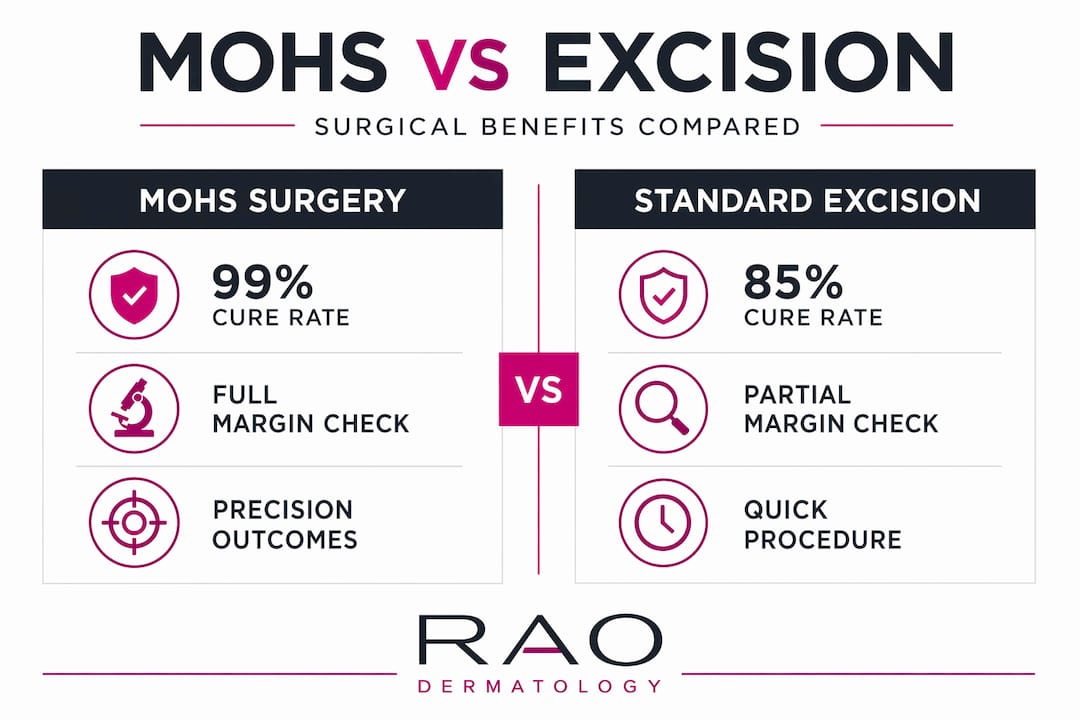
| Feature | Mohs surgery | Standard excision |
|---|---|---|
| Margin analysis coverage | 100% of margins examined | Approximately 1% of margins examined |
| Cure rate (primary BCC) | Up to 99% | 90 to 95% |
| 10-year recurrence rate | 4.4% recurrence | 12.2% recurrence |
| Tissue preservation | Maximum, only affected tissue removed | Broader margins removed as a safety buffer |
| Pathology turnaround | Real-time, same appointment | Days to a week |
| Scar size | Typically smaller | Typically larger |
Beyond the statistics, there are two benefits that patients consistently say matter most to them after the fact. First, the certainty. Knowing that 100% of the tumor edges were checked before you left the building is genuinely reassuring in a way that waiting a week for standard pathology results is not. Second, the tissue preservation. Removing the minimum amount of healthy tissue translates directly into smaller wounds, less complex reconstruction, and better long-term cosmetic results.
That said, Mohs is not always the right choice. Smaller, low-risk tumors in non-sensitive areas may do equally well with a straightforward excision at lower cost and with less time investment. The goal is matching the treatment to the tumor, not defaulting to the most intensive option for every case.
Pro Tip: Ask your surgeon specifically about the tumor subtype and whether the location qualifies as cosmetically sensitive. Those two factors together are usually the clearest indicators that Mohs is the right call.
What to expect before, during, and after Mohs surgery
The patient experience during Mohs surgery procedure is often different from what people expect, and the gap between expectation and reality is where anxiety tends to live. Here is a realistic picture of the full patient journey.
Before your procedure
- Stop blood-thinning medications only if your surgeon specifically instructs you to. Never stop a medication without physician approval.
- Eat a normal meal beforehand. Local anesthesia does not require fasting.
- Wear comfortable, loose clothing appropriate for the site being treated. For face procedures, avoid anything that pulls over your head.
- Arrange a ride home if your surgeon recommends it. While most patients drive themselves without issue, certain sites or extensive procedures may make it preferable to have someone else at the wheel.
- Plan for a full day. Because the process involves multiple stages with waiting periods, appointments can run four to eight hours even if the actual cutting time is short.
During the procedure
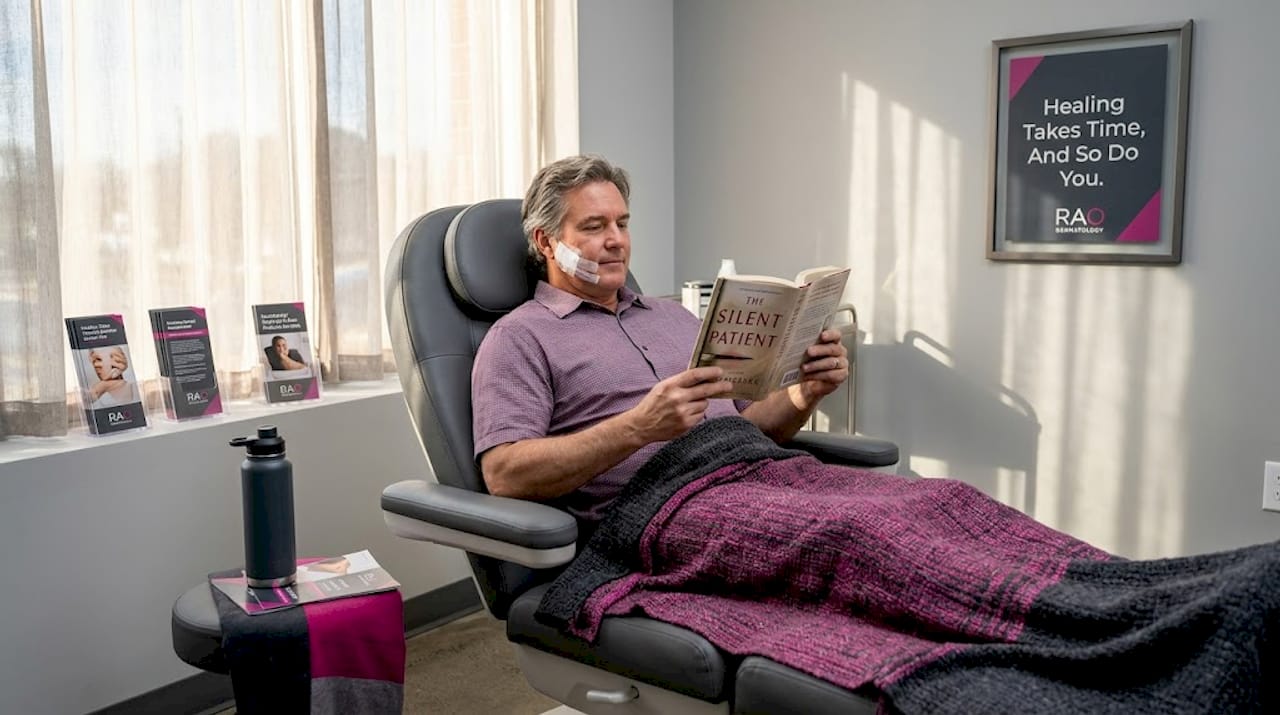
You will be awake the entire time. Local anesthesia numbs the site thoroughly, so you will feel pressure or movement but not pain. Between stages, you wait in a comfortable area with your wound bandaged. Most patients read, scroll, or chat with staff during these intervals. If a second or third stage is needed, the surgeon reinjects anesthesia and continues. The number of stages is not known in advance and depends entirely on how the tumor extends under the skin.
After the procedure and recovery
Wound closure after Mohs is chosen based on the size and location of the defect. Options include:
- Primary closure. Simple sutures when the wound is small and skin can be pulled together easily.
- Flap repair. Nearby skin is rotated or advanced to cover the defect, common on the face where natural tension lines help conceal scars.
- Skin graft. Skin from another site is used when local tissue is insufficient.
- Secondary intention. Some wounds are left to heal on their own, which can produce excellent cosmetic results in specific locations.
Recovery from Mohs surgery typically involves one to two weeks of wound care with gentle cleaning, antibiotic ointment, and a bandage. Sutures come out at one to two weeks depending on location. Swelling and bruising are normal, particularly around the eyes or nose. Full scar maturation takes 12 to 18 months, and most scars continue to fade significantly during that window.
Pro Tip: Sun protection over your scar during the first year makes a measurable difference in long-term appearance. UV exposure to a healing scar causes permanent darkening that does not reverse.
My perspective on what Mohs surgery really means for patients
I’ve seen the moment many patients realize what Mohs surgery actually accomplishes, and it almost always comes after the procedure, not before. Before surgery, most people focus on the fear of what’s being removed. Afterward, they talk about what was saved.
In my experience, the biggest disservice we do to patients is framing Mohs as “more surgery.” It isn’t more surgery. It is more precise surgery. The difference in tissue removed between Mohs and a standard wide excision on a nose or eyelid can be the difference between a barely visible scar and a reconstruction that changes your appearance permanently.
What I’ve also found is that patients consistently underestimate the mental preparation required for the waiting periods. You’re awake, you’re anxious, and you’re sitting with a bandaged wound while someone looks at your cells under a microscope. That’s not nothing. Preparing for that reality practically, with something to do and someone to call, changes the experience meaningfully.
The evolving evidence on Mohs in melanoma treatment is something I think more patients should know about. For years, melanoma was considered largely outside the Mohs indication set. That’s shifting, and patients with certain subtypes deserve to know that expanded options may exist.
The bottom line, from where I stand: Mohs surgery doesn’t just treat cancer. When performed for the right indication, it protects the version of yourself you want to see in the mirror afterward.
— Krunal
Precision skin cancer care at Raodermatology

If you’re weighing your treatment options after a skin cancer diagnosis, you deserve care built around precision and experience. At Raodermatology, Dr. Babar K. Rao and his team bring 25-plus years of expertise to skin cancer treatment across California, New Jersey, and New York. From early detection and dermatopathology services that confirm your diagnosis with certainty, to specialized Mohs surgery performed with tissue-sparing precision, every step of your care is coordinated in one practice. Explore all available services or contact Raodermatology to schedule a consultation and get answers specific to your case.
FAQ
What is Mohs surgery used to treat?
Mohs surgery is most commonly used to treat basal cell carcinoma and squamous cell carcinoma, especially in cosmetically sensitive locations like the face, ears, and hands. It is also used for recurrent or high-risk tumors where complete margin control is critical.
How does Mohs surgery work differently from regular excision?
Mohs surgery examines 100% of the removed tissue margins in real time during the procedure, while standard excision typically evaluates less than 1% of margins after the fact. This allows the surgeon to confirm complete cancer removal before the patient leaves.
Is Mohs surgery safe?
Yes. Mohs surgery is performed under local anesthesia as an outpatient procedure, and cure rates reach up to 99% for primary basal cell carcinoma with substantially lower recurrence than standard techniques.
What does recovery from Mohs surgery involve?
Recovery from Mohs surgery typically includes one to two weeks of wound care with antibiotic ointment and bandaging. Full scar maturation takes up to 18 months, though most patients return to normal activities within days of the procedure.
How long does a Mohs surgery appointment take?
Plan for a full day. While the actual surgical time per stage is short, waiting for tissue to be processed and examined between stages means the total appointment often runs four to eight hours from start to finish.
Recommended
Filed under: