
Navigate your dermatologist visit workflow with confidence! This guide prepares you for every step, ensuring a smooth and informative appointment.

Walking into a dermatologist’s office without knowing what to expect is more common than most people admit. Whether you’re in California tracking a suspicious mole, in New Jersey managing a psoriasis flare, or in New York booking your first cosmetic consultation, the experience can feel rushed, confusing, or just plain unclear. This guide is built specifically for you. It unpacks every phase of the dermatology visit workflow, from paperwork to post-visit clarity, so you can walk in prepared, use your time well, and leave with real answers rather than more questions.
Table of Contents
- What to know before your dermatologist visit
- Step-by-step workflow: What actually happens during your visit
- How visit agendas are aligned with your preferences: Patient-centered tools in use
- Tips for better results: Avoid common mistakes and maximize your appointment time
- Our take: What most guides miss about effective dermatologist workflows
- Get the most from your next dermatologist visit with expert help
- Frequently asked questions
Key Takeaways
| Point | Details |
|---|---|
| Prep is crucial | Arriving with clear questions, forms, and medications boosts the value of your visit. |
| Workflow depends on complexity | Appointment length and steps change based on your condition, chosen treatments, and if procedures are performed. |
| Patient-centered tools streamline care | Pre-visit surveys and agenda alignment save time and prevent missed concerns. |
| Know expected costs | Pricing ranges by state and appointment type, so understanding expectations avoids surprises. |
| Active participation matters | Clearly sharing your care goals leads to more effective dermatologist visits. |
What to know before your dermatologist visit
Before you even park the car, it helps to understand that not all dermatology appointments are built the same. A routine skin screening takes far less time and carries different expectations than a first consultation for plaque psoriasis or a session discussing cosmetic fillers. Knowing which type of visit you’re booking changes how you prepare.
Visit types and what they actually mean:
- Routine skin exam: A head-to-toe visual inspection to catch early signs of skin cancer or abnormal growths. Typically 15 to 20 minutes.
- Complex medical visit: Managing conditions like psoriasis, eczema, or rosacea, especially when systemic therapy (medications that work throughout the body) is involved. These often run 30 to 45 minutes.
- Cosmetic consultation: Discussing treatments such as Botox, fillers, chemical peels, or laser resurfacing. Time varies based on the number of concerns and whether a same-day treatment is planned.
- Follow-up appointment: A check-in after a procedure, biopsy result, or medication adjustment. Usually shorter, 10 to 20 minutes.
Appointment length is not arbitrary. It directly reflects the clinical complexity your provider needs to address. Knowing this upfront prevents the frustration of feeling shortchanged on time.
Cost basics for CA, NJ, and NY patients:
One of the most anxiety-producing parts of any healthcare visit is cost. Based on skin exam pricing by state, the cost and price expectations for dermatologist visits depend on location, type of exam, and the number of areas examined. These figures shift once procedures like biopsies, injections, or systemic treatment evaluations are added. Insurance coverage also plays a major role, so calling your insurer before the appointment to confirm in-network status and co-pay amounts can save you real money and real stress.
| Visit type | Typical duration | Factors that raise cost |
|---|---|---|
| Routine skin exam | 15–20 min | Additional areas, biopsies |
| Psoriasis/complex medical | 30–45 min | Systemic therapy, labs |
| Cosmetic consultation | 20–40 min | Same-day treatment, multiple concerns |
| Post-procedure follow-up | 10–20 min | Lab review, medication change |
What to bring with you:
- A complete list of all current medications, including over-the-counter products and supplements
- Photos of any skin changes you’ve noticed at home (time-stamped photos are especially helpful)
- Your insurance card and a valid photo ID
- Any prior dermatology records, biopsy reports, or pathology results
- A written list of your top concerns, ranked by priority
- Pre-visit forms completed in advance, ideally through the patient portal
Pro Tip: If you’re coming in for a medical issue, avoid applying heavy moisturizers, makeup, or nail polish before your visit. These can obscure lesions and slow down the exam.
Good preparation for your dermatology appointment is not just a nicety. It’s the single biggest factor you control that determines whether your visit is productive or frustrating.
Step-by-step workflow: What actually happens during your visit
With the groundwork set, it’s time to walk through exactly what your appointment will look like, start to finish.
1. Arrival and check-in (5–10 minutes) You arrive, present your ID and insurance, and confirm your demographics. If you haven’t already completed intake forms digitally, a staff member will hand them to you on paper. Front desk staff also verify your insurance eligibility in real time at many practices, so arriving 10 minutes early matters more than most patients realize.
2. Rooming and vital signs (5 minutes) A medical assistant escorts you to the exam room, confirms your reason for the visit, checks your blood pressure or weight if clinically relevant, and reviews your medication list. This is also when digital pre-visit questionnaires are often administered, since you’re already seated and waiting.
3. Provider intake and history (5–15 minutes) Your dermatologist or a resident enters and reviews your history, asking about your skin concern timeline, prior treatments, family history of skin cancer, and any recent changes. For psoriasis patients, the provider will also assess disease severity using a standardized scoring tool (called PASI, the Psoriasis Area and Severity Index) before discussing therapy options.
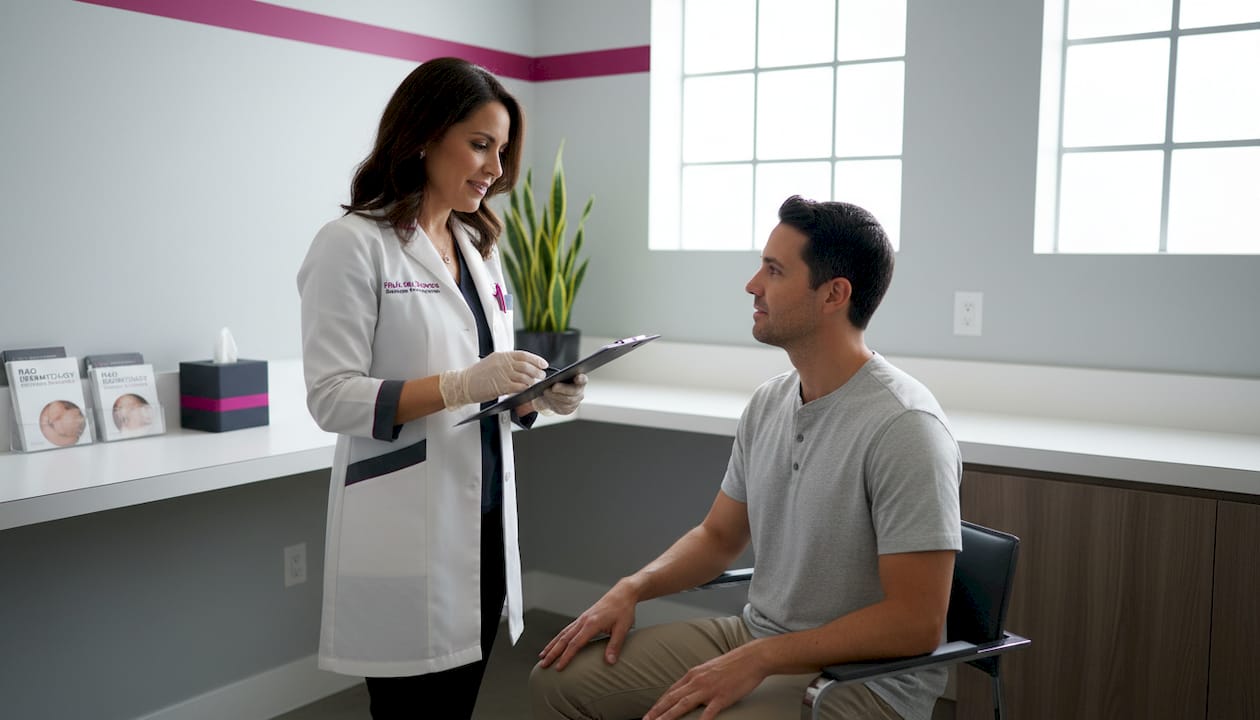
4. Physical examination (10–20 minutes) This is the heart of the visit. For skin cancer screenings, the provider will examine your entire body surface including your scalp, nails, and between the toes. For psoriasis or eczema, the focus narrows to affected areas. For cosmetic consultations, the provider evaluates facial anatomy, skin quality, and volume distribution before recommending any treatment.
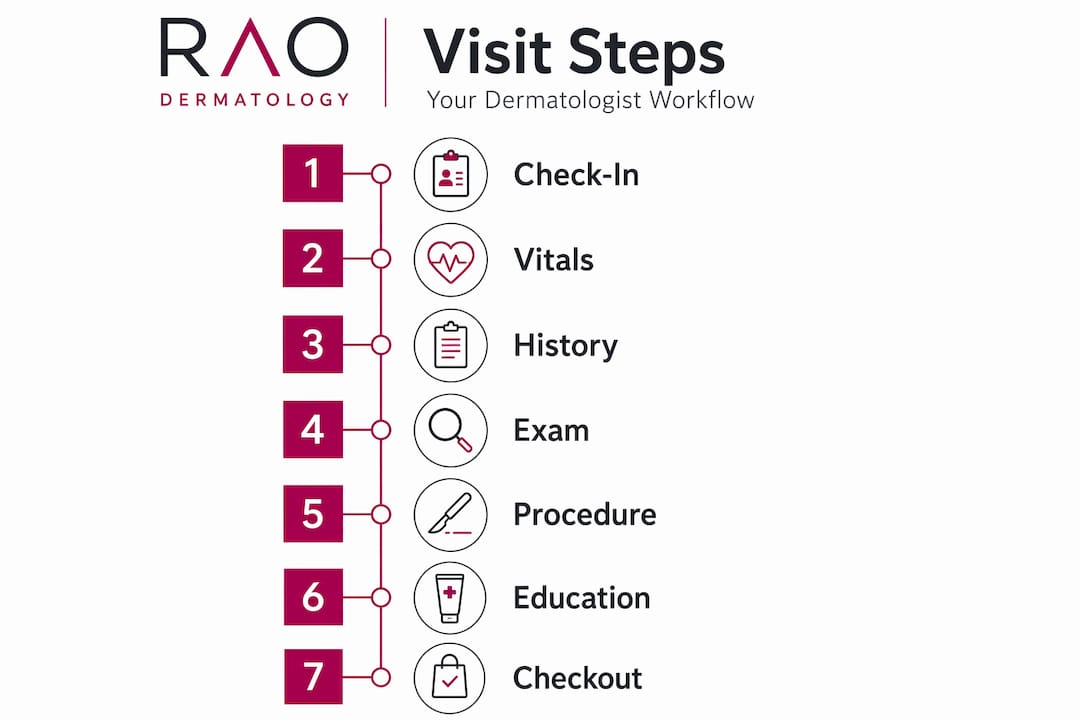
5. Procedures, if needed (variable) Clinical complexity and procedure load strongly affect scheduling. Skin cancer evaluations involving a biopsy add 15 to 30 minutes. Psoriasis cases with systemic therapy discussions add another 10 to 20 minutes for counseling. Cosmetic procedures performed same-day, such as filler injections, can add 20 to 45 minutes depending on the areas treated.
6. Education and shared decision-making (5–10 minutes) After the exam or procedure, your provider explains findings, reviews the treatment plan, and gives you a chance to ask questions. This phase is where most patients feel rushed because providers are often behind schedule. Having your questions written down in advance is the best way to protect this time.
7. Checkout and next steps (5 minutes) The front desk processes your visit, schedules any follow-ups, and hands you printed or digital after-visit instructions. If a biopsy was taken, you’ll be told the expected turnaround time for pathology results, typically 5 to 10 business days.
| Appointment type | Total typical duration | Key time drivers |
|---|---|---|
| Skin cancer screening | 20–35 min | Body surface area, lesion count |
| Biopsy or Mohs eval | 45–90 min | Number of lesions, surgery complexity |
| Psoriasis management | 30–50 min | Systemic therapy, severity scoring |
| Cosmetic consult + treatment | 45–75 min | Areas treated, product volume |
If you’re coming in specifically for skin cancer diagnosis or Mohs surgery, plan for a longer appointment and arrange transportation, since some procedures involve staged rounds and extended time in the office.
For patients managing chronic conditions, understanding the psoriasis vs eczema treatment process before your appointment helps you ask more targeted questions and get more out of the visit. Similarly, if aesthetics are your focus, reviewing what a cosmetic visit consultation typically covers will reduce surprises on the day.
Pro Tip: If you have a complex case involving multiple concerns, call the scheduling team ahead of time and ask for an extended appointment slot. Most practices can accommodate this if you give advance notice.
How visit agendas are aligned with your preferences: Patient-centered tools in use
Now that you’ve seen the usual steps, here’s how your voice and priorities are woven into the workflow through structured patient-centered tools.
The most forward-thinking dermatology practices now use brief structured questionnaires to make sure the visit agenda matches what the patient actually needs, not just what’s written on the referral form. Research published in the Journal of Clinical and Aesthetic Dermatology confirms that structured pre-visit tools help align the visit with each patient’s decision-making and care preferences, reducing “agenda creep” and improving efficiency even in shorter appointments.
“A 4-question framework that identifies a patient’s cognitive and decision-making style can transform a 15-minute visit from a rushed transaction into a focused, meaningful clinical exchange.”
What these tools look like in practice:
- A short digital or paper form completed after you’re roomed and before the provider enters
- Questions about your decision-making style: do you prefer detailed explanations, or just the key points?
- Questions about your priorities: Is managing flares your top concern, or are you focused on long-term prevention?
- A prompt to rank your top two or three agenda items so the provider addresses the most important ones first
These tools are not about collecting data for data’s sake. They reduce the all-too-common scenario where you leave the office realizing the one concern you cared most about never came up. They also give providers permission to focus, which makes the visit feel more thorough even when time is tight.
Benefits you’ll notice as a patient:
- Visits feel more organized and respectful of your time
- Your preferences around treatment approach are discussed, not assumed
- The provider references your answers during the encounter, which builds trust
- You’re less likely to feel like you were rushed through a checklist
For patients working through visit preparation strategies, understanding that these intake tools exist, and that you can engage with them thoughtfully, is a real advantage. Similarly, for aesthetic appointments, many practices now use cosmetic intake tools that capture your aesthetic goals, past treatments, and comfort with specific procedures before the provider even walks in.
Tips for better results: Avoid common mistakes and maximize your appointment time
Now, let’s zoom out from structured tools to practical ways you can save time during your visit and leave satisfied every time.
Most common mistakes patients make:
- Showing up without a medication list, leading to 5 to 10 wasted minutes reconstructing it from memory
- Listing concerns verbally in no particular order, causing the most important issue to get bumped to the end
- Forgetting to mention over-the-counter treatments, since these directly affect how a provider interprets your skin’s condition
- Arriving late and losing the intake time that would have established your priorities
- Not using the patient portal to send questions in advance, which can dramatically shorten the history-taking phase
How to maximize every minute:
- Write your top three concerns on paper or in your phone before you leave home, ranked in order of importance
- Bring a complete medication list in writing, including dosages and how long you’ve been taking each one
- Use the patient portal or call ahead the day before to share any updates, new photos, or questions
- For complex conditions like psoriasis or a post-biopsy review, ask during scheduling how much time is allocated and whether you should expect any same-day procedures
Research consistently shows that structured pre-visit tools aligned with patient decision-making preferences prevent agenda creep, which is what happens when minor concerns crowd out the reason you booked the appointment in the first place.
For complex or specialized appointments:
- Psoriasis patients: Use the visit preparation checklist and document your flare frequency, triggers, and response to past treatments before arriving.
- Skin cancer patients: Know the name and location of any previously treated lesions. Bring prior pathology reports if you have them.
- Cosmetic patients: Bring reference photos of outcomes you like, and be specific about the areas you want to address. Saying “I want to look refreshed” is far less useful than “I’m bothered by the lines between my brows and the volume loss in my cheeks.”
Patients preparing for psoriasis or eczema visits should also note whether their symptoms change seasonally, since this pattern information directly influences whether a provider recommends topical, phototherapy, or systemic treatment.
Pro Tip: After your visit, write down the key points from your provider’s recommendations before you leave the parking lot. Memory of medical information drops significantly within an hour of receiving it.
Our take: What most guides miss about effective dermatologist workflows
Having looked at practical steps, here’s our perspective on why many guides still overlook the human factor in dermatology workflows.
Most articles about dermatology visits focus heavily on logistics: what to bring, how long it takes, what a biopsy involves. That’s useful. But it misses something foundational. The real quality of a dermatology visit is not determined by its length. It’s determined by whether the patient and provider are actually aligned on what matters most in that encounter.
We’ve seen patients come in after 30-minute appointments at other practices feeling more confused than when they arrived. And we’ve seen incredibly productive 15-minute visits where every minute counted because both sides came in prepared and focused. The difference is almost always intentional agenda-setting, on both sides of the exam table.
Here’s what the research doesn’t always say plainly: efficiency and quality are not the same thing. A rushed visit that checks every clinical box but leaves the patient unclear on their treatment plan or anxious about a biopsy result is not a good visit. It’s a completed transaction. That distinction matters enormously, especially in markets like California, New Jersey, and New York, where appointment demand is high and time pressure is real.
Patients who understand why preparation matters and who come in with a clear, prioritized agenda consistently report higher satisfaction and better adherence to treatment plans. This is not coincidence. When you advocate for your own agenda, your provider has the context to give you a more personalized, accurate plan. The intake survey tools we discussed earlier are valuable precisely because they formalize this process and make it consistent rather than accidental.
The best dermatology practices treat every visit as a co-created experience. Not something done to you, but something built with you.
Get the most from your next dermatologist visit with expert help
Ready to put these tips into action? Here’s how Rao Dermatology streamlines each step of the visit for patients like you.
At Rao Dermatology, structured workflows are not just best practices. They are the standard at every location across California, New Jersey, and New York. With 25+ years of experience leading medical and cosmetic dermatology, Dr. Babar K. Rao’s team is built to handle everything from routine skin screenings to advanced Mohs surgery and aesthetic enhancements, all within a patient-centered model that prioritizes your agenda as much as clinical efficiency.
Whether you are managing a complex condition or exploring cosmetic options, our full range of dermatology services is designed to match your pace and priorities. From skin cancer prevention and treatment to cosmetic dermatology enhancements, our teams bring both clinical depth and genuine care to every appointment. Book a visit at a location near you and experience what a truly well-structured dermatology visit feels like.
Frequently asked questions
How long will my dermatology appointment take if I have more than one concern?
Appointment duration increases with complexity and may range from 15 to 45 minutes or more for multiple issues, especially when systemic management or procedures are involved.
Will I need a biopsy or same-day procedure during a skin cancer check?
If a suspicious lesion is found, your provider may perform a biopsy during the same appointment, and skin cancer evaluation and biopsy can add 15 to 30 minutes depending on the number of lesions.
How much does a typical skin exam cost in California, New Jersey, or New York?
According to CareCredit, average skin exam costs are $93 in California, $83 in New Jersey, and $82 in New York, though fees rise with visit complexity and additional services.
What can I do to help my appointment run smoothly?
Preparing a ranked list of concerns, bringing your medication list, and completing intake forms in advance can improve both efficiency and satisfaction, as pre-visit alignment tools show consistently across dermatology practices.
Recommended
- How to prepare for your dermatology appointment: a step-by-step guide | Rao Dermatology
- Your step-by-step cosmetic dermatology consultation guide | Rao Dermatology
- Essential Questions to Ask Your Dermatologist During Your Next Visit | Rao Dermatology
- How to Find a Dermatologist: Steps for Expert Skin Care | Rao Dermatology
Filed under: