
Learn the essential steps for effective skin cancer screening. This guide covers self-exams and professional tips for early detection.
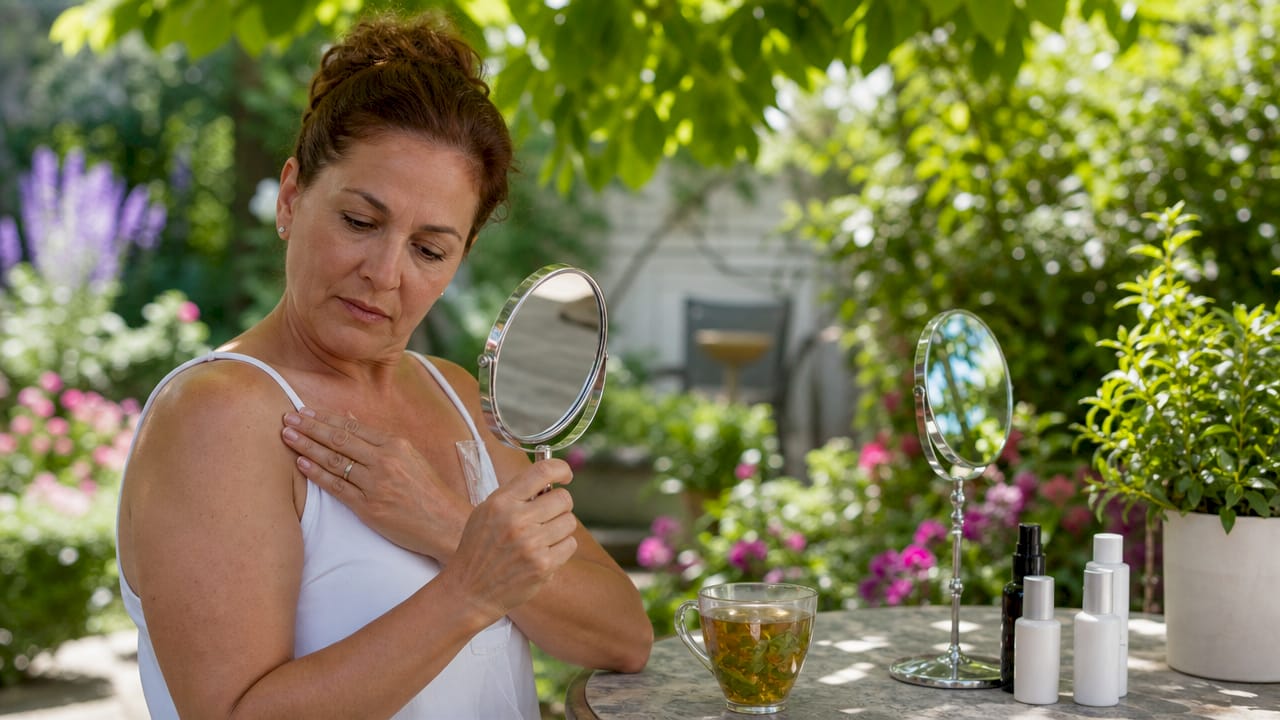
Step by step skin cancer screening is a systematic process of examining every inch of your skin to catch early signs of cancer before they become life-threatening. The American Academy of Dermatology recognizes both self-exams and professional full-body exams as critical tools in early detection. Skin cancer is the most common cancer in the United States, and catching it early dramatically improves treatment outcomes. This guide walks you through everything: what tools you need, how to examine each body area, what a dermatologist does during a clinical exam, and how to interpret what you find.
What tools do you need for an effective skin cancer self-exam?
A thorough skin cancer self-exam requires the right setup. Rushing through it in a dim bathroom with no mirror misses the point entirely. The goal is to see every surface of your skin clearly, including areas you rarely look at.
Gather these items before you start:
- A full-length mirror mounted on a wall or door
- A handheld mirror for hard-to-see areas like the back of your neck and scalp
- Bright, natural or white artificial lighting (avoid yellow-tinted bulbs)
- A comb or blow dryer to part your hair and expose the scalp
- A smartphone or camera to document any spots you want to track
Good lighting is the single most important factor. Shadows hide color changes and border irregularities, which are two of the key warning signs you are looking for. A well-lit room with overhead lighting and a secondary lamp eliminates most blind spots.
Pro Tip: Take dated photographs of moles and spots each time you do a self-exam. Comparing photos from three months apart reveals gradual changes that memory alone will miss.
Set aside at least 15 minutes. Rushing leads to skipped areas. Do the exam after a shower when your skin is clean and you are already undressed.
How to do a step by step skin cancer self-screening
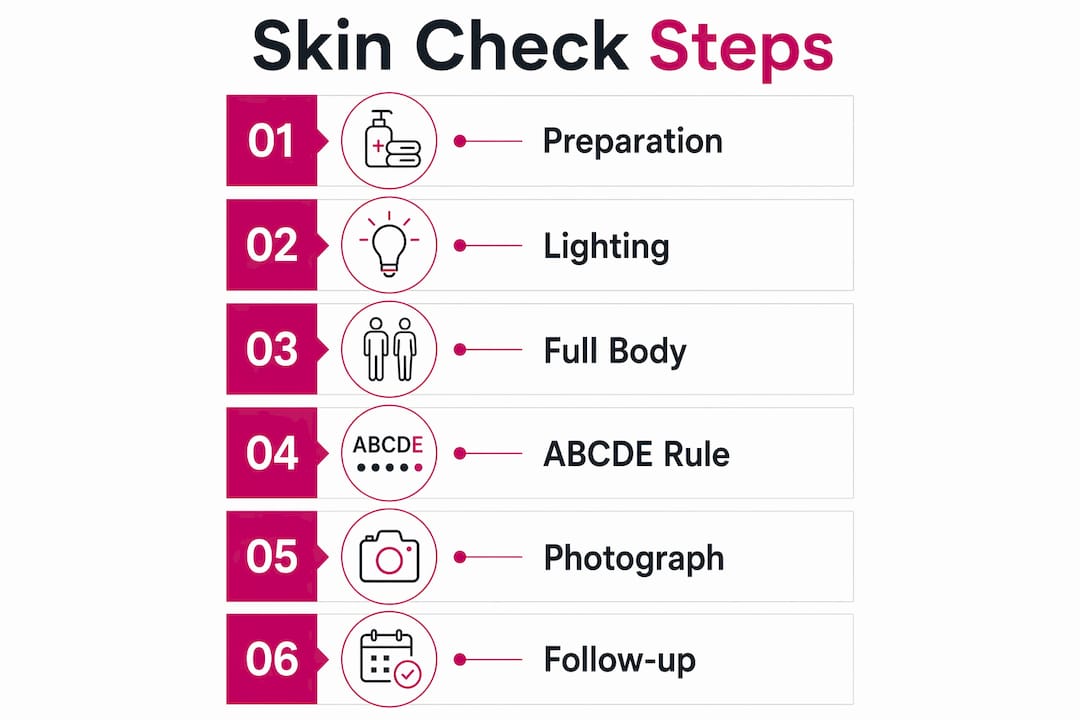
A full-body self-exam follows a top-to-bottom sequence. This order prevents you from skipping areas and builds a repeatable habit. The ABCDE rule is your evaluation framework throughout: Asymmetry, Border irregularity, Color variation, Diameter over 6mm, and Evolving changes.
-
Scalp. Use a comb or blow dryer to part your hair in sections. Use the handheld mirror or ask a partner to check areas you cannot see. The scalp is one of the most commonly missed spots.
-
Face. Examine your forehead, nose, lips, and cheeks in the full-length mirror. Pay close attention to the nose bridge and the area around your lips, both of which receive heavy sun exposure.
-
Ears. Check the front and back of each ear, including the area behind the ear where it meets the skull. Use the handheld mirror.
-
Neck and chest. Examine the front and sides of your neck. Open your shirt and check your chest and upper abdomen. Men often overlook the chest; women should check the skin under the breasts.
-
Arms and hands. Raise each arm and check the underarm area. Move down to your forearms, elbows, and the backs of your hands. Check between each finger and under your fingernails.
-
Back and buttocks. Use the handheld mirror facing the full-length mirror to see your upper and lower back. Check the buttocks and the skin between the buttocks.
-
Legs and feet. Sit down and examine the front and back of each leg. Check the soles of your feet, between your toes, and under your toenails.
Comprehensive screening covers the scalp, behind the ears, palms, soles, fingernails, and between the toes. These are the areas patients most often skip.
Pro Tip: Check areas that rarely see sunlight, including your genitals and the skin between your toes. Melanoma can develop anywhere on the body, not just on sun-exposed skin. See Raodermatology’s at-home skin cancer check guide for a printable checklist.
Apply the ABCDE rule to every mole or spot you examine. A mole that is perfectly round, one color, smaller than a pencil eraser, and unchanged over time is almost always benign. A spot that is irregular in shape, has multiple shades of brown or black, or has grown recently deserves medical attention.
What happens during a professional skin cancer screening?
A clinical skin exam is not the same as a self-exam. A dermatologist uses specialized tools and trained pattern recognition to identify lesions that are invisible to the untrained eye.
What to expect during the appointment:
- You will be asked to undress and wear a gown so the provider can examine all skin surfaces
- The exam typically lasts 10–15 minutes for a standard full-body check
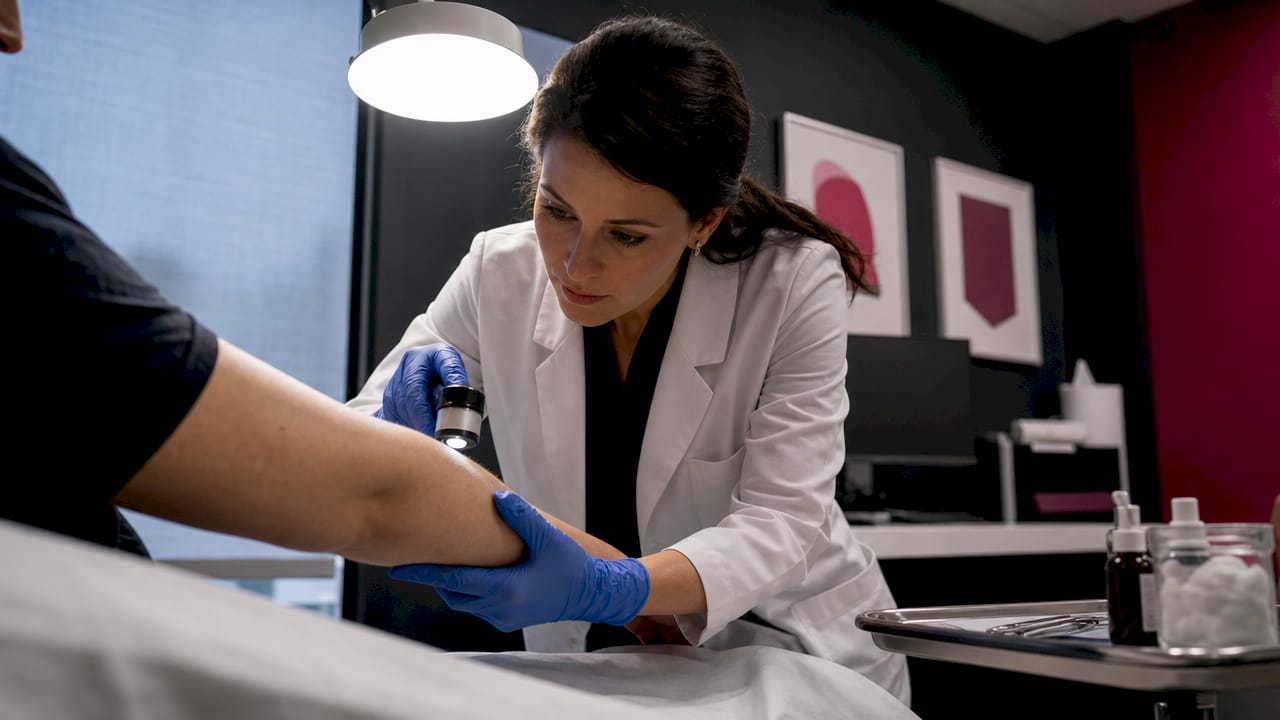
- The dermatologist uses a dermatoscope, a handheld magnifying device with polarized light, to inspect suspicious lesions
- Dermatoscopy identifies precancerous and cancerous lesions that are invisible to the naked eye
- The provider examines your scalp, behind your ears, between your fingers, the soles of your feet, and all other skin surfaces
If the dermatologist finds a suspicious lesion, a biopsy is the next step. A biopsy is a quick in-office procedure performed under local anesthesia with minimal discomfort. Biopsy results typically take 7–10 business days to return from the laboratory.
| Stage | What happens | Time frame |
|---|---|---|
| Full-body visual exam | Dermatologist inspects all skin surfaces | 10–15 minutes |
| Dermatoscopy | Magnified inspection of suspicious spots | During exam |
| Biopsy (if needed) | Tissue sample removed under local anesthesia | Same appointment |
| Lab results | Pathology confirms or rules out cancer | 7–10 business days |
Most adults should have a professional full-body skin exam annually. Patients with a personal or family history of skin cancer, fair skin, or significant sun exposure history should schedule exams every six months.
How to interpret findings and when to seek medical help
Not every unusual spot is cancer. The goal of a self-exam is to notice change, not to diagnose. That distinction matters because it keeps you from either ignoring real warning signs or panicking over a harmless freckle.
Seek medical attention promptly if you notice any of the following:
- A mole or spot that has changed in size, shape, or color since your last exam
- A sore that does not heal within four weeks
- A spot that bleeds without being scratched or injured
- A new growth that looks different from all other spots on your body (dermatologists call this the “ugly duckling” sign)
- Any lesion that itches, crusts, or oozes persistently
The “E” in the ABCDE rule, which stands for evolving, is the most critical indicator. A spot that changes over weeks or months is more concerning than a large but stable mole. Photographic records make this comparison objective and reliable.
“Self-exams are not only about spotting existing cancer. They are about becoming intimately familiar with your skin’s normal variations so that early changes stand out immediately.”
Do not delay a consultation out of fear. A biopsy is quick, minimally uncomfortable, and the only definitive way to confirm or rule out skin cancer. Early-stage skin cancer is highly treatable. Waiting makes treatment more complex.
Common mistakes that reduce the effectiveness of your skin checks
Most people who do self-exams still miss things. The problem is almost never effort. It is technique and consistency.
The most common mistakes:
- Skipping the scalp, nail beds, and the skin between the toes
- Using poor lighting that hides color changes
- Relying on memory instead of dated photographs and written notes
- Doing self-exams irregularly instead of monthly
- Avoiding a partner’s help for hard-to-see areas like the back
The buddy system is genuinely useful. Asking a trusted person to check your back, scalp, and behind your ears takes two minutes and covers the areas most likely to be missed. This is not optional for people with a lot of moles or a history of sun damage.
Pro Tip: Set a recurring monthly reminder on your phone. Pair your skin check with an existing habit, such as the first Sunday of each month after your shower. Consistency matters more than perfection.
Schedule annual professional screenings alongside your monthly self-exams. The two practices complement each other. Self-exams catch changes between appointments; professional exams catch what you cannot see or evaluate on your own.
Key takeaways
Early detection through a consistent skin cancer screening routine is the single most effective way to improve outcomes, combining monthly self-exams with annual professional full-body checks.
| Point | Details |
|---|---|
| Use the ABCDE rule | Evaluate every mole for asymmetry, border, color, diameter, and evolving changes. |
| Document with photos | Take dated photos each month to objectively track changes over time. |
| Cover all body areas | Check scalp, nail beds, soles, and between toes — not just sun-exposed skin. |
| See a dermatologist annually | Most adults need a professional full-body exam once a year; higher-risk patients need every six months. |
| Act on changes promptly | Any spot that changes, bleeds, or does not heal within four weeks warrants a medical consultation. |
Why I think most people underestimate the self-exam
Most patients I talk to treat self-exams as a backup plan. They assume the annual dermatology visit covers everything. That assumption is wrong, and it costs people time they cannot get back.
A dermatologist sees your skin once a year for 10–15 minutes. You see it every day. Self-exams build a mental map of your skin that no clinician can replicate. That map is what lets you notice when something shifts. Subtle changes, a mole that looks slightly darker, a spot that used to be flat and now has a raised edge, are things only you will catch between visits.
The patients who find melanoma early are almost always the ones who were paying attention. They were not medical professionals. They just knew their skin well enough to notice something was off. That is the real value of a monthly skin check. It is not about diagnosing yourself. It is about knowing your baseline so that change becomes obvious.
My honest advice: treat your monthly self-exam as seriously as you treat any other health habit. Use photos. Use good lighting. Ask for help with hard-to-see areas. And when something changes, do not wait to see if it goes away on its own. Book the appointment. The importance of early detection cannot be overstated. Every week of delay on a suspicious lesion is a week you cannot recover.
— Krunal
Raodermatology’s skin cancer screening and prevention services
Raodermatology has provided expert skin cancer detection and treatment across California, New Jersey, and New York for over 25 years. The practice uses dermatoscopy and advanced diagnostic tools to identify lesions that standard visual exams miss.

If your self-exam has raised concerns, or if you have not had a professional skin check in the past year, Raodermatology’s clinical team is ready to help. The practice offers full-body skin cancer screening and treatment with same-week appointments available at multiple locations. For patients who need biopsy confirmation, Raodermatology’s dermatopathology services provide fast, accurate laboratory analysis in-house. Contact the practice to schedule your screening and get a clear picture of your skin health.
FAQ
What is the ABCDE rule in skin cancer screening?
The ABCDE rule stands for Asymmetry, Border irregularity, Color variation, Diameter over 6mm, and Evolving changes. It is the standard framework dermatologists use to evaluate whether a mole or spot warrants further investigation.
How often should I do a skin cancer self-exam?
Perform a full-body self-exam once a month. Monthly checks build familiarity with your skin’s normal appearance, making it easier to spot changes early.
How long does a professional skin cancer screening take?
A professional full-body exam typically takes 10–15 minutes. If a suspicious lesion is found, a biopsy may be performed during the same visit.
When should I see a dermatologist after a self-exam?
See a dermatologist promptly if you notice a mole that has changed in size, shape, or color, a sore that does not heal within four weeks, or any spot that bleeds without injury.
Do I need a professional screening if I do monthly self-exams?
Yes. Self-exams and professional screenings serve different purposes. A dermatologist uses a dermatoscope to detect lesions invisible to the naked eye, which self-exams cannot replicate.
Recommended
- Your At-Home Skin Cancer Check: A Step-by-Step Guide | Rao Dermatology
- Annual Skin Cancer Screening: Your Complete Guide to Dermatology Checkups | Rao Dermatology
- Skin cancer screening: early detection and prevention | Rao Dermatology
- Complete Guide to At-Home Skin Cancer Checks: What You Need to Know | Rao Dermatology
Filed under: