
Discover the benefits of laser removal for skin tags, including minimal bruising and a quick recovery. Learn essential tips before booking!

Laser removal is a solid option for most skin tags when a trained medical professional handles it. The main draw is cosmetic: lasers seal blood vessels as they cut, so you get a bloodless field, minimal bruising, and often no stitches. The trade-off is that healing can run a bit longer than a simple snip, and there’s a real risk of temporary pigment changes, especially on darker skin. Before anything gets treated, see a board-certified dermatologist. That exam rules out anything suspicious and determines whether laser, snip excision, or another method fits your specific tag.
Key Takeaways
Laser removal works best for multiple small skin tags in visible areas, offering a bloodless procedure with a healing timeline of one to three weeks depending on the laser type used.
| Point | Details |
|---|---|
| Laser fits specific cases best | Multiple small tags in visible areas benefit most from a bloodless laser approach. |
| Exam comes before treatment | A board-certified dermatologist should rule out suspicious lesions before any removal method. |
| Healing takes one to three weeks | Crusting resolves in one to two weeks; some laser types leave necrotic tissue for up to three. |
| High-volume sessions are safe | One study documented 1,257 tags removed across 68 patients in a single session. |
| Rao Dermatology offers full evaluation and removal | Board-certified dermatologists match the method to the tag across California, New Jersey, and New York locations. |
Table of Contents
- How Does Laser Removal Of Skin Tags Actually Work?
- What Types Of Lasers Are Used For Skin Tag Removal?
- How Does Laser Compare With Snip Excision, Electrosurgery, And Cryotherapy?
- Are You A Good Candidate For Laser Skin Tag Removal?
- What Happens During A Laser Removal Appointment?
- What Are The Risks And Realistic Healing Timeline?
- How Much Does Laser Skin Tag Removal Cost, And How Many Tags Per Visit?
- What Aftercare Do You Need After Laser Skin Tag Removal?
- How Do You Choose Who Performs Your Removal?
- A Clinical Perspective On Choosing The Right Removal Method
- How Rao Dermatology Can Help With Skin Tag Removal
- Sources
- FAQ
How Does Laser Removal Of Skin Tags Actually Work?
A laser destroys the skin tag by converting light energy into heat at the treatment site, which coagulates blood vessels and breaks down the tissue holding the tag in place. The stalk either whitens and shrinks on contact or gets vaporized outright, depending on the laser type and settings the clinician chooses.
Clinicians watch for a handful of visual cues during treatment to know the laser is doing its job:
- Immediate whitening of the tag’s surface, a sign the tissue protein is coagulating.
- Slight puckering or shrinkage of the stalk as heat contracts the collagen inside it.
- Light crusting forming within minutes, which usually means the vessel has sealed.
- No active bleeding during or right after the pass, the hallmark of a properly cauterized field.
Once those endpoints show up, the clinician stops. Overtreating a small tag doesn’t make it fall off faster. It just increases the odds of an ugly mark left behind.
What Types Of Lasers Are Used For Skin Tag Removal?

Dermatologists reach for a handful of laser families depending on tag size, location, and skin tone, plus one non-laser device that still comes up constantly in the same conversation: radiocautery.
CO2 lasers work through direct vaporization. The beam is absorbed by water in the tissue, which ablates the tag layer by layer. StatPearls’ clinical overview notes that CO2 lasers are typically reserved for smaller tags because the ablative effect, while precise, carries a higher chance of a visible mark if used on thicker lesions.
Nd:YAG lasers, including 532 nm and picosecond variants, work more by selective photothermal absorption in blood vessels feeding the tag, causing it to blanch and eventually slough. A split-neck pilot study compared a picosecond 532 nm Nd:YAG laser against a long-pulsed 755 nm alexandrite laser on multiple tags on the same patient’s neck. Both cleared the tags in one session with only transient redness and crusting, and no lasting scarring or pigment change turned up at follow-up.
Alexandrite lasers at 755 nm target pigment and vasculature with a longer pulse, which tends to be gentler on surrounding skin than straight ablation. That same pilot study found it performed comparably to the picosecond Nd:YAG for multiple small tags, with minimal discomfort reported.
Radiocautery and electrosurgery aren’t lasers, but they’re the comparison every dermatology practice makes because they solve the same problem: a bloodless field. StatPearls describes radiocautery as fast, precise, and easy to control, which is why it remains a workhorse alongside laser options rather than something lasers have simply replaced.
The right choice usually comes down to tag size, how many need treating in one visit, and how your skin has reacted to heat-based procedures before.
How Does Laser Compare With Snip Excision, Electrosurgery, And Cryotherapy?
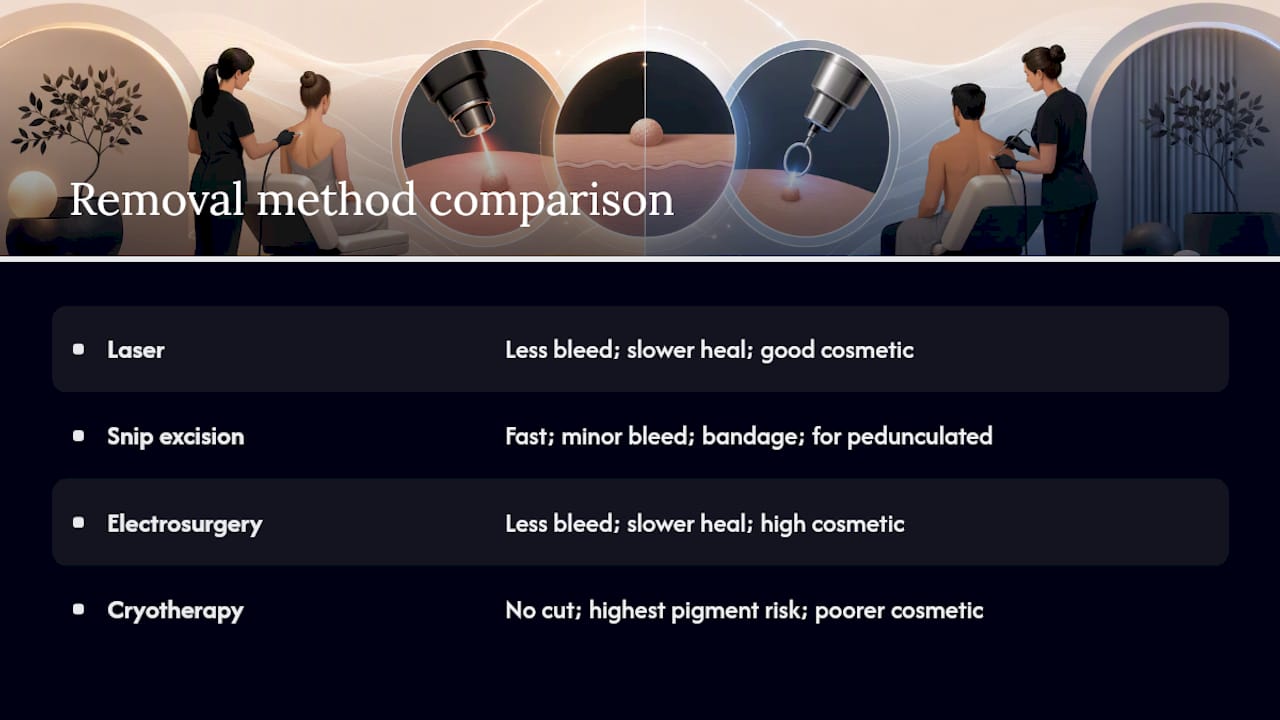
Every removal method trades something for something else. Snip excision is fast and gives you an immediately visible result, but it draws a small amount of blood and needs a bandage. Laser and electrosurgery skip the bleeding but can take longer to fully heal. Cryotherapy avoids any cutting at all but comes with the highest rate of pigment complications among common office methods.
A 2025 systematic review found that electrosurgery and laser treatments consistently scored higher for patient-reported cosmetic outcomes than cryotherapy, which showed a notably higher rate of pigmentary change. A randomized, observer-blinded trial comparing scissor excision against a non-ablative 532 nm laser reported durable results for both, meaning treated tags generally didn’t come back, though the two methods differed in healing speed and immediate cosmetic appearance.
Large, dangling, pedunculated tags often do better with a quick snip since the stalk is easy to grab and the wound is tiny. Small tags scattered across the neck or underarms, where you’d rather not deal with multiple small dressings, tend to be a better fit for laser or radiocautery. Delicate spots like the eyelid margin call for extra caution and usually favor the clinician’s most controlled tool for that location, decided case by case at your consultation. For a broader look at how Rao Dermatology approaches treatment selection, a consultation walks through which method fits your specific tags.
Are You A Good Candidate For Laser Skin Tag Removal?
Laser tends to make the most sense for people who have several small tags in areas where scarring would bother them most, like the neck, eyelids, or underarms, and who want to avoid a wound that needs a bandage. It’s also a common pick when someone has been burned before, literally, by a rough healing experience with another method.
Good candidates typically have:
- Multiple small tags clustered in a cosmetically visible area.
- A strong preference for minimal bleeding and no sutures.
- Tags in delicate spots where precision matters more than speed.
- No active anticoagulant use that would complicate bleeding control (though this rarely rules laser out entirely).
Situations that steer a dermatologist toward a different approach or a pause:
- Large, thick, pedunculated tags, where a simple snip is often faster and just as clean.
- A lesion that has changed shape, color, or size recently, which needs evaluation before any removal method is considered.
- Irregular borders, ulceration, or unexplained bleeding from the growth itself, all of which call for a biopsy first.
- Active skin infection at the site, or pregnancy, where clinicians often adjust timing or technique.
The single most important step here isn’t picking a laser type. It’s getting an actual exam. Scripps Health’s clinical guidance is blunt about this: even a growth that looks exactly like a typical skin tag deserves a professional look before treatment, because a small number of skin cancers can mimic a benign tag closely enough to fool an untrained eye.
What Happens During A Laser Removal Appointment?
A typical visit starts with a quick visual exam of each tag, followed by numbing if the area is sensitive or if there are several tags to treat, then a series of short laser passes, and finally a brief round of aftercare instructions before you walk out. Most patients are in and out within 30 to 45 minutes for a handful of tags.
Small tags often don’t need any anesthesia at all. The sensation is usually described as a quick snap or a warm pinch, over almost as soon as it starts. For larger tags or a bigger cluster, the clinician may apply a topical numbing cream or a small local injection first.
One thing that surprises a lot of patients: how many tags can realistically be handled in a single visit. A 2025 comparative study documented a single session in which 68 patients had a combined 1,257 fibromas removed, which works out to roughly 18 tags per person on average, all cleared safely in one appointment. Volume isn’t usually the limiting factor. Total treatment time and the patient’s comfort tolerance are what determine the pace.
Before your visit, mention any blood thinners, recent isotretinoin use, or a history of keloid scarring. Worth asking your clinician directly: which laser they’re planning to use, what the expected healing timeline looks like for your skin type, and whether they’ve treated your specific skin tone with that device before.
What Are The Risks And Realistic Healing Timeline?
Most people sail through healing with nothing more than mild crusting and some pink discoloration that fades on its own. The predictable, expected effects include transient redness right after treatment, a thin crust or scab that forms within a day or two, and in some laser types, a small patch of necrotic tissue that can take up to roughly three weeks to fully shed.
- Crusting: typically resolves in one to two weeks; don’t pick at it.
- Transient erythema: pink or red discoloration that usually calms down within days.
- Necrotic shedding: with certain ablative lasers, dead tissue can persist longer, sometimes close to three weeks before it’s fully gone.
- Postinflammatory hyperpigmentation (PIH): dark or light patches that can linger for weeks to months, more common in medium and darker skin tones.
- Scarring: uncommon with proper technique, but a possibility with any heat-based method if endpoints are overshot.
- Infection: rare, but a real risk if aftercare instructions get skipped.
Patients with darker Fitzpatrick skin types face a meaningfully higher chance of pigment changes with any thermal method, laser included, which is exactly why an experienced provider adjusts settings, pulse duration, or even which laser they choose based on your skin tone rather than using one setting for everyone.
Call the clinic if you notice bleeding that won’t stop with light pressure, a wound that’s getting more painful or red instead of less over the following days, pus or a foul odor, or a treated spot that seems to be growing back rather than healing. Clinicians typically manage these with topical antibiotics, a follow-up visit, or, rarely, a small revision procedure.
How Much Does Laser Skin Tag Removal Cost, And How Many Tags Per Visit?
Pricing usually falls into one of three models: a flat per-lesion fee, a bundled office-visit charge that covers a set number of tags, or a time-based fee when a large cluster needs a longer appointment. What drives the final number is the size and number of tags, the laser technology used, and whether the visit is billed as cosmetic or medically necessary.
Cosmetic removal, meaning tags with no functional or diagnostic concern, is typically an out-of-pocket cost, since most insurance plans classify it as elective. If a tag is irritated, bleeding repeatedly, or located somewhere it catches on clothing and causes real discomfort, insurance coverage becomes a conversation worth having at your consultation, since that shifts the removal from purely cosmetic to medically indicated.
On volume, the evidence backs up something a lot of patients don’t expect: clinicians can safely clear a large number of tags in one sitting. That same comparative study with 1,257 fibromas removed across 68 patients is the clearest data point here, showing high-volume single-session treatment is both feasible and safe when performed by an experienced provider. Your own count will depend on tag size and your tolerance for the appointment length, but there’s rarely a hard cap that forces multiple visits just to clear a handful of small tags.
What Aftercare Do You Need After Laser Skin Tag Removal?
Keep the treated area clean, protected from sun, and largely left alone for the first week or two. Most healing problems come from over-touching the site, not from the procedure itself.
- Clean gently with mild soap and water once daily; avoid scrubbing.
- Apply a thin layer of ointment if your clinician recommends one, to keep the area from drying out and cracking.
- Skip swimming pools, hot tubs, and heavy sweating for at least a few days to reduce infection risk.
- Avoid picking at crusts or scabs, which is the single most common cause of avoidable scarring.
- Keep the site out of direct sun, or cover it, since fresh healing skin is especially prone to pigment changes.
Pro Tip: If your treated tag was on your neck, chest, or another spot that gets regular sun exposure, apply a broad-spectrum sunscreen daily once the skin has closed over, even on cloudy days. Early, consistent sun protection is one of the most effective ways to lower your odds of postinflammatory hyperpigmentation.
Most small tags heal on their own without a scheduled check-in. Larger clusters, treatment near the eye, or anyone with a history of slow healing usually gets a follow-up visit built into the plan from the start. Cleveland Clinic’s guidance is also direct about one thing worth repeating here: skip the at-home remedies entirely. Tea tree oil, apple cider vinegar, and tying off a tag with dental floss show up constantly in home-remedy forums, but none of them have real clinical backing, and all carry a meaningful risk of burns, contact dermatitis, or infection that a five-minute office visit avoids.
How Do You Choose Who Performs Your Removal?
Look for board certification first. A board-certified dermatologist has the training to distinguish a harmless skin tag from something that needs a biopsy, which matters more than most patients realize until they’ve seen a case where it mattered.
Beyond certification, a few practical signs point to a clinic that does this well: documented before-and-after photos across a range of skin tones, a clear explanation of consent and expected healing before you’re on the table, and a straightforward policy on what happens if a complication comes up.
At your consultation, it’s fair to ask directly which laser type the clinician plans to use and why, what endpoint they’re aiming for during treatment, how long healing usually takes for a tag your size and location, and how they’d rate your personal risk for pigment change given your skin tone. A provider who answers these specifics without hesitation is usually one who’s done this procedure often enough to know the answers cold. You can read more about how lasers are used across dermatology procedures generally if you want the broader technical picture before your visit.
A Clinical Perspective On Choosing The Right Removal Method
In practice, the decision usually isn’t laser versus everything else. It’s matching the tool to the tag. Large, dangling, pedunculated tags on the torso or underarms are still often removed fastest and just as cleanly with a simple snip. Where laser earns its place is with clusters of small tags on visible skin, the neck, the eyelids, places where a patient cares deeply about the cosmetic result and wants to avoid multiple small wounds healing at once.
Patient satisfaction tends to track expectations more than technique. Someone who understands going in that crusting is normal, that pigment changes are possible, and that full healing might take a couple of weeks is far less likely to feel disappointed than someone expecting a spotless result the next morning. The technical outcome and the reported satisfaction aren’t always the same conversation.
The one piece of advice worth repeating without exception: skip the home remedies. Tying off a tag, freezing it with an over-the-counter kit, or dabbing on essential oils isn’t a shortcut to the same result a clinician gets in five minutes with the right tool. It’s a shortcut to a burn, an infection, or a missed diagnosis on something that wasn’t actually a skin tag at all.
How Rao Dermatology Can Help With Skin Tag Removal
If you’re weighing laser against a quick snip or electrosurgery, Rao Dermatology gives you both the diagnostic step and the removal in the same visit, with board-certified dermatologists who choose the method based on your tags rather than using a one-size-fits-all protocol.

At a Rao Dermatology appointment, your dermatologist examines each tag first to confirm it’s benign, discusses which removal method fits your skin type and the tag’s location, and walks you through the procedure and healing timeline before treating anything. If a tag is irritated or medically indicated for removal, the visit can also connect to a skin cancer screening evaluation, which matters if anything looks atypical, or to dermatopathology services if a biopsy is warranted. With locations across California, New Jersey, and New York, scheduling a consultation is usually the fastest way to get a straight answer on what your specific tags need. Visit Rao Dermatology’s services page to book an evaluation and ask about coverage if your removal is medically necessary rather than purely cosmetic.
Sources
- Comparative study reporting high-volume single-session fibroma removal
- A Pilot Split-Neck Case Study to Compare the Efficacy of the Long-Pulsed 755 nm Laser and the 532 nm Picosecond Laser for Acrochordon Removal
- Skin Tag (Acrochordon) - StatPearls - NCBI Bookshelf
- Best Cosmetic Outcomes for Skin Tag Removal: A Systematic Review of Treatment Modalities and Patient-Reported Aesthetic Results
- Avoid at-home options and trust medical professionals to cut, burn or freeze off skin tags - Cleveland Clinic
This article is general information, not a substitute for advice from a qualified doctor. Consult a qualified healthcare professional about your own circumstances before acting on anything here.
FAQ
How much does it cost to laser off a skin tag?
Pricing varies by clinic, tag size, and how many tags need treating, with cosmetic removal typically billed out-of-pocket and medically necessary removal sometimes covered by insurance. Ask for a personalized estimate during your consultation, since a flat published rate rarely reflects the final cost.
What naturally kills skin tags off at home?
Nothing with real clinical backing. Home remedies like tea tree oil, apple cider vinegar, and tying off a tag with dental floss lack evidence and carry a real risk of burns, contact dermatitis, or infection, which is why Cleveland Clinic recommends professional removal instead.
Do skin tags grow back after removal?
A properly treated skin tag typically does not regrow at the same site, according to a randomized trial comparing scissor excision and laser removal that found durable results with both methods. New tags can still develop elsewhere on the body over time, since they’re often related to skin friction and aging rather than a single cause.
How many skin tags can be removed in one session?
Quite a lot, when appropriate. A 2025 comparative study documented 1,257 fibromas removed across 68 patients in a single session, showing that high-volume treatment in one visit is both feasible and safe under professional care. Your own visit length depends on total tag count and your comfort tolerance rather than a fixed limit.
Recommended
- Professional Skin Tag Removal: Safe Treatment Options & What to Expect | Rao Dermatology
- Skin Tag Removal: When to Consider Treatment and Your Options | Rao Dermatology
- Professional Skin Tag Removal: Why Choose a Dermatologist Over DIY Methods | Rao Dermatology
- Professional Skin Tag Removal: Is It Right for You? | Rao Dermatology | Rao Dermatology
Filed under: