
Discover effective strategies for hand eczema treatment, including trigger avoidance and emollient use, for lasting relief.
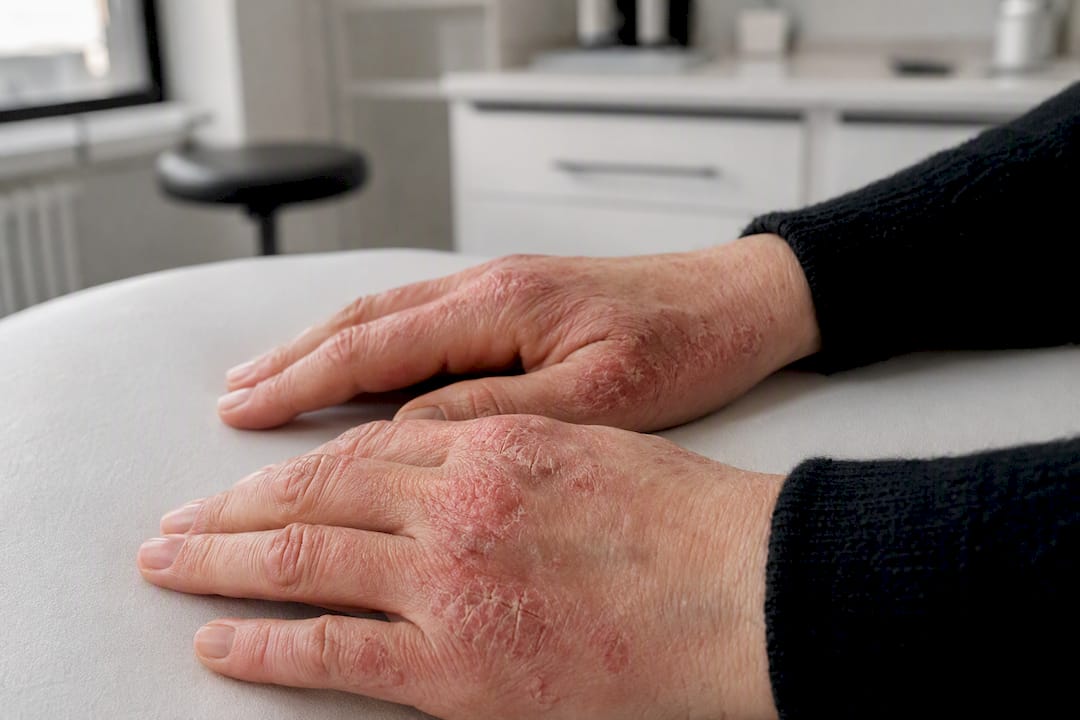
Start trigger avoidance and frequent emollients today. Add a short course of a topical corticosteroid for active flares, and see a dermatologist if the skin cracks, bleeds, gets infected, or fails to improve after a few weeks of consistent home care. For chronic cases that keep coming back despite steroid use, topical delgocitinib is now an FDA-approved option specifically for patients whose hand eczema hasn’t responded well to topical corticosteroids.
That’s the short version. The longer version depends on which subtype you have, what’s triggering it, and how severe the flares have gotten. Here’s what to do right now:
- Moisturize aggressively. Apply a thick, fragrance-free ointment frequently throughout the day and after every handwash, not just when your hands feel dry.
- Identify and cut the trigger. Wet work, harsh soaps, and glove sensitivities are the most common culprits, and removing them often matters more than any prescription.
- Use a mid-to-high potency topical steroid for active flares, but only for the duration your dermatologist recommends, since prolonged use thins the skin.
- Call a dermatologist promptly if you see pus, spreading redness, fever, deep painful fissures, or if your hands are too impaired to work or grip objects normally.
Key Takeaways
Effective hand eczema treatment follows a strict sequence: barrier repair and trigger avoidance first, topical corticosteroids for flares second, and options like topical delgocitinib or systemic therapy reserved for cases that don’t respond to the basics.
| Point | Details |
|---|---|
| Moisturize as foundation | Apply fragrance-free emollient after every wash and four to six times daily, ointment at night. |
| Match steroid potency to location | Use higher potency on palms, lower potency on hand backs, and limit continuous use to avoid thinning. |
| Know the delgocitinib option | Topical delgocitinib is FDA-approved for chronic hand eczema that hasn’t improved with topical corticosteroids. |
| Write a flare plan | Define exactly when to start a steroid, when to stop, and when to call your dermatologist. |
| Escalate when basics fail | Rao Dermatology offers patch testing, prescription topicals, and specialist care for persistent cases. |
Table of Contents
- Hand Eczema Treatment: Recognizing Symptoms and Subtypes First
- What Causes Hand Eczema to Flare Up?
- How Is Hand Eczema Diagnosed?
- Treatment for Hand Eczema: The Full Escalation Ladder
- Building Your Flare-Management Plan
- When Should You See a Dermatologist for Hand Eczema?
- Daily Hand Eczema Care: A Simple Checklist
- Rao Dermatology’s Approach to Hand Eczema Care
- An Evidence-First Take on Hand Eczema Care
- Get Hand Eczema Under Control With Rao Dermatology
- Sources
- FAQ
Hand Eczema Treatment: Recognizing Symptoms and Subtypes First
Getting the right treatment starts with knowing exactly what you’re dealing with, because “hand eczema” is really an umbrella term covering several distinct patterns. The core symptoms overlap across subtypes: persistent dryness, redness, itching, and often visible cracking or fissures across the knuckles and palms. What separates ordinary dry skin from hand eczema is the pattern: eczema tends to flare in the same spots repeatedly, resists regular lotion, and often comes with intense itching or a burning sensation rather than simple tightness.
Irritant contact dermatitis shows up most in people doing repeated wet work, think nurses, food service workers, hairdressers, and parents of young kids. The skin becomes red, dry, and scaly, usually worse on the backs of the hands and between fingers.
Allergic contact dermatitis looks similar but stems from a true immune reaction to a specific substance, often fragrance, nickel, rubber accelerators, or certain preservatives. It can appear days after exposure, which makes the trigger harder to pin down without testing.
Dyshidrotic eczema (pompholyx) is its own distinct pattern: small, intensely itchy blisters along the sides of the fingers and palms, sometimes clear and fluid-filled, sometimes deeper and painful. This subtype often flares with stress, sweating, or seasonal humidity changes, and dyshidrotic eczema treatment frequently requires a different approach than irritant dermatitis because the blistering stage responds better to drying, astringent soaks before moisturizer goes on.
Atopic-related hand eczema appears in people with a personal or family history of eczema, asthma, or allergies, and it often coexists with eczema on the eyelids, elbows, or knees. If you’re managing eyelid eczema treatment alongside hand symptoms, mention both to your dermatologist. They frequently share an underlying atopic driver.
Hyperkeratotic hand eczema is the chronic, thickened form: skin that’s become leathery, scaly, and deeply fissured after months or years of unresolved inflammation.
Before your appointment, photograph your hands during a flare, note the time of day symptoms worsen, and track any product you touched in the 24 to 48 hours beforehand. That timeline often reveals the trigger faster than any lab test.
What Causes Hand Eczema to Flare Up?
Most hand eczema traces back to one of a handful of repeat offenders, and figuring out which one applies to you is often more useful than any cream.
- Wet work is the single biggest driver. Frequent handwashing, dishwashing, or any job requiring gloved, sweaty hands for hours strips the skin’s natural barrier faster than it can repair itself. Nurses, hairstylists, and cleaners see this constantly.
- Detergents and solvents break down the same barrier chemically. Dish soap, industrial cleaners, and even some “gentle” hand soaps contain surfactants that dissolve the lipids holding skin cells together.
- Glove-related triggers are sneaky. Latex allergy gets attention, but the rubber accelerators used to manufacture gloves, plus sweat trapped underneath during long wear, cause at least as much irritation as the latex itself.
- Occupational exposures compound everything. Cement, adhesives, hairdressing chemicals, and food juices from raw meat or citrus are common allergic or irritant triggers depending on your line of work.
- True allergic contact dermatitis develops after repeated exposure to a specific allergen, nickel in tools or jewelry, fragrance in lotions, or preservatives in cosmetics, and it can take weeks or months of exposure before a reaction even shows up.
The practical difference matters: irritant reactions improve once you reduce exposure and rebuild the barrier, while allergic reactions require identifying and permanently avoiding the specific substance, since even small future exposures can retrigger a flare.
Two quick home experiments can save you weeks of guessing. First, stop using any new product introduced in the past month, switch to nitrile gloves instead of latex, and cut wet-work time in half for two weeks. If your hands improve, you’ve likely found an irritant. Second, if symptoms persist despite those changes, or if the pattern suggests a specific allergen (a reaction localized to where a ring or watch sits, for instance), ask your dermatologist about patch testing.
How Is Hand Eczema Diagnosed?
Diagnosis usually starts with a conversation, not a test. Your dermatologist will ask about your occupation, hobbies, when the rash started, what makes it better or worse, and every product that touches your hands: soaps, lotions, gloves, cleaning supplies, even hobby materials like paint or adhesive.
The physical exam looks for specific patterns: whether the eczema affects the backs of the hands versus the palms, whether there’s blistering versus scaling, and whether other areas of atopic skin (elbows, eyelids, neck) are involved. That distribution often points toward a subtype before any lab work happens.
Patch testing gets ordered when allergic contact dermatitis is suspected, especially in cases that don’t respond to typical irritant-avoidance measures. Small amounts of common allergens are applied to the back under adhesive patches and read after 48 and 96 hours. It’s not painful, but it does require two or three separate office visits.
- Bring a list of every product you use at home and at work, including brand names.
- Note occupational exposures specifically, since workplace chemicals are a leading cause of missed diagnoses.
- Track flare frequency and severity over several weeks if possible; this data helps your clinician judge whether you need escalation beyond topical steroids.
- Mention any prior eczema, asthma, or allergy history, since atopic background changes the treatment approach.
Severity scoring tools like the Hand Eczema Severity Index (HECSI) help clinicians measure how much a flare has progressed and whether a treatment is actually working between visits. Tracking your own flares with photos and a simple diary gives your dermatologist real data instead of a vague “it’s been bad lately,” which speeds up the decision to escalate treatment when first-line measures aren’t cutting it.
Treatment for Hand Eczema: The Full Escalation Ladder
Effective hand eczema treatment follows a hierarchy: build a strong skin barrier first, calm active inflammation second, and reserve stronger systemic options for cases that don’t respond to the basics. Skipping straight to the strongest option rarely works better and often causes more side effects than starting at the bottom and escalating deliberately.
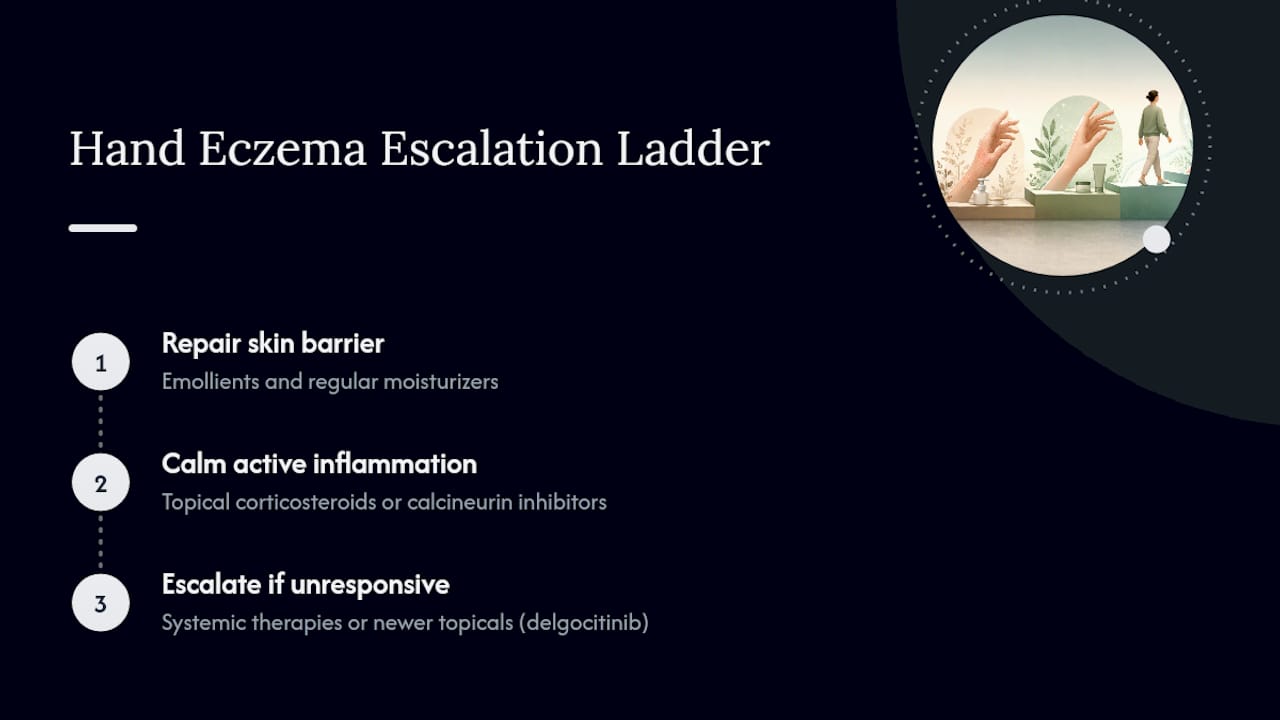
Baseline emollient care
Moisturizer is not an afterthought here, it’s the foundation everything else builds on; understanding the role of skin barrier repair in skin health can deepen your approach to effective treatment. Reviews of hand eczema management consistently identify baseline emollient use alongside barrier protection as core, non-negotiable treatment, even though no single moisturizer brand has been shown superior in head-to-head trials.
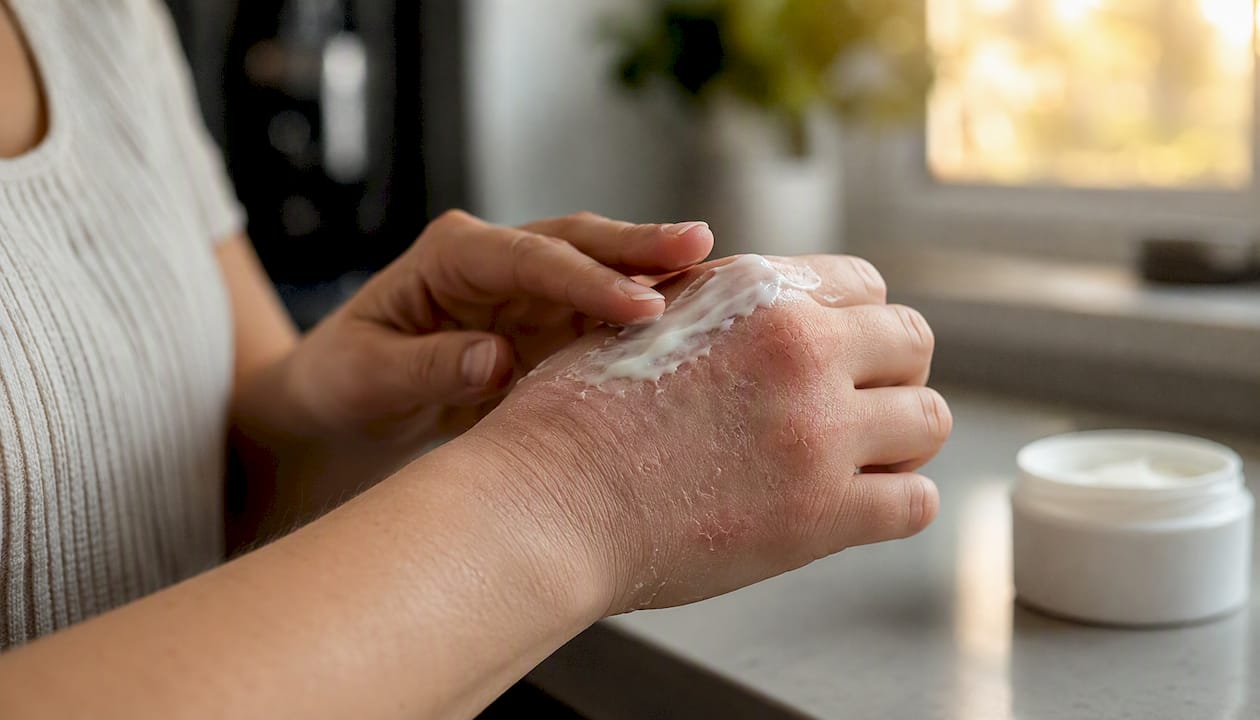
Ointments (thicker, greasier, more occlusive) work better for very dry or cracked skin, especially overnight. Creams absorb faster and feel more tolerable during the day when you need to keep using your hands. Apply moisturizer within a few minutes of washing, while skin is still slightly damp, and reapply frequently during a flare. Choose fragrance-free formulas; added scent is one of the most common allergic triggers in exactly the population trying to treat eczema.
Topical corticosteroids
For active inflammation, topical corticosteroids remain the fastest way to bring down redness, itch, and swelling. Potency selection depends on location: the palms have thick skin and often need a higher-potency steroid to penetrate effectively, while the thinner skin on the backs of the hands responds to lower potency and needs it to avoid thinning.
Duration matters as much as potency. Continuous high-potency steroid use raises real risks, skin atrophy, stretch marks, and a rebound phenomenon sometimes called steroid withdrawal, so guideline recommendations favor short, defined courses followed by tapering or a switch to a nonsteroid option rather than indefinite daily use.
Pro Tip: Apply topical steroids in a thin layer only to actively inflamed skin, then layer your regular moisturizer over it once absorbed. Treating the whole hand with steroid cream “just in case” is one of the most common ways people accidentally trigger skin thinning.
Topical calcineurin inhibitors
Tacrolimus and pimecrolimus offer a steroid-sparing alternative, particularly useful for maintenance between flares or for areas where you’re worried about long-term steroid thinning, like the backs of the hands or skin near the wrists. They work more slowly than steroids and can cause a temporary burning sensation on application, but they don’t carry the atrophy risk, making them a reasonable bridge therapy for chronic, low-grade inflammation.
Topical delgocitinib: a newer option for steroid-refractory cases
Topical delgocitinib is FDA-approved specifically for moderate-to-severe chronic hand eczema in patients who haven’t responded adequately to topical corticosteroids. It works differently than steroids, targeting inflammatory signaling directly through a class of drug called a JAK inhibitor, applied topically rather than systemically.
What the trials showed: Phase III data from the DELTA trial program found significantly higher rates of patients achieving clear or almost-clear skin (measured by IGA-CHE scores of 0 or 1) and meaningful HECSI score reductions compared with vehicle cream, along with itch relief starting as early as the first day of treatment for many patients. Adverse event rates in trials were comparable between delgocitinib and vehicle, though ongoing monitoring for application-site reactions is standard practice.
A 2026 expert consensus on chronic hand eczema management in the United States describes delgocitinib as currently the only FDA-approved topical medication specifically for chronic hand eczema in patients who can’t rely on topical corticosteroids alone, positioning it as a distinct rung in the treatment ladder rather than a replacement for baseline care.
Systemic therapy and phototherapy for refractory disease
When topical measures fail, or when hand eczema is severe enough to interfere with work and daily function, dermatologists consider systemic options. These come with real trade-offs and require lab monitoring, so they’re reserved for cases that have genuinely exhausted topical steps:
- Alitretinoin, an oral retinoin used in some regions for severe chronic hand eczema unresponsive to steroids, requires monitoring for lipid and liver effects and strict pregnancy precautions given its retinoid class.
- Narrowband UVB phototherapy applied to the hands can help chronic, thickened eczema respond over several weeks of regular in-office or take-home sessions.
- Methotrexate or cyclosporine, traditional immunosuppressants, are sometimes used for widespread or resistant disease, with regular bloodwork to monitor liver and kidney function.
- Biologics like dupilumab, originally developed for atopic dermatitis broadly, are used off-label or considered in select refractory hand eczema cases with an atopic component.
Secondary bacterial infection, common when fissures crack open and stay moist, needs its own treatment track: topical antiseptics for mild cases, oral antibiotics when infection is spreading or the hands show pus, warmth, or worsening pain despite standard eczema care.
Building Your Flare-Management Plan
A written flare plan turns “wait and see” into a system you actually follow, and expert guidance on chronic hand eczema stresses that a formalized, patient-specific plan prevents the drift into chronic, hard-to-treat disease that happens when flares just get ignored until they’re unbearable.
Here’s a template you can adapt with your dermatologist:
- Daily baseline, every day, flare or not: Moisturize after every handwash, minimum four applications daily, ointment at night.
- At the first sign of a flare (new redness, itching, or a blister): Start your prescribed topical corticosteroid on the affected area only, continuing baseline moisturizer everywhere else.
- If no improvement within one to two weeks: Call your dermatologist rather than continuing the steroid indefinitely; extended high-potency use raises thinning risk.
- If flares keep recurring despite steroid courses: Ask about transitioning to a calcineurin inhibitor for maintenance or discuss topical delgocitinib as a next step.
- If hands are severely affected, infected, or function is impaired: Same-week dermatology visit, not a wait-and-see approach.
Prevention lives mostly in glove strategy. Nitrile or PVC gloves outperform latex for most people with hand eczema, both because latex triggers true allergy in some patients and because the rubber accelerators used in manufacturing irritate already-compromised skin. Cotton liners underneath reduce the sweating that makes occlusive glove wear counterproductive, and limiting continuous glove-wearing time, taking them off periodically to air out hands, matters more than people expect.
Pro Tip: Keep a travel-size tube of barrier cream at your workstation, not just at home. The moment most people skip their routine is mid-day at work, exactly when wet work and repeated handwashing do the most damage.
If your job involves heavy wet work or chemical exposure, a direct conversation with your employer about accommodations, different gloves, task rotation, access to a sink with milder soap, is a reasonable and often successful request, particularly once you have a dermatologist’s note specifying the medical need.
When Should You See a Dermatologist for Hand Eczema?
Some situations call for a dermatology visit immediately rather than trying more over-the-counter measures first:
- Hands that are bleeding, deeply fissured, or too painful to use normally for work or daily tasks.
- Signs of infection: pus, spreading warmth and redness, fever, or a wound that isn’t healing.
- No meaningful improvement after two to three weeks of consistent moisturizing and appropriate over-the-counter care.
- Recurrent flares that keep coming back in the same pattern, suggesting an unidentified trigger or a need for prescription-strength treatment.
A dermatologist can offer what home care can’t: patch testing to nail down allergens, prescription-strength topical corticosteroids matched to your specific skin thickness and severity, and access to options like phototherapy, systemic agents, or topical delgocitinib for cases that have outgrown basic measures.
Timeline expectations matter here, too. Itch relief from an appropriately potent topical steroid or delgocitinib often starts within days. Full barrier recovery, the skin actually looking and feeling normal again, typically takes several weeks to a few months of consistent care. Chronic cases may need an ongoing maintenance strategy indefinitely rather than a one-time fix, which is exactly why a written flare plan matters more than a single prescription.
Daily Hand Eczema Care: A Simple Checklist
- Wash with a soap substitute, not regular soap. Fragrance-free, low-pH cleansers reduce barrier stripping compared to standard bar or liquid soap.
- Pat, don’t rub, hands dry with a soft towel, leaving them slightly damp before the next step.
- Apply moisturizer within minutes of drying, while skin is still a little damp, using cream during the day and a thicker ointment at night.
- Reapply moisturizer after every handwash and at least four to six times total across the day, not just when hands feel visibly dry.
- At night, apply a heavier ointment and consider cotton gloves over it to boost absorption and protect sheets or bedding, since ointment can make hands slippery and, near open flames or stovetops, poses a minor fire risk worth being aware of.
- Keep a small tube of moisturizer wherever you spend most of your day, home, car, desk, so reapplication actually happens instead of getting skipped.
Rao Dermatology’s Approach to Hand Eczema Care
Rao Dermatology has built its clinical dermatology practice under Dr. Babar K. Rao around exactly this kind of staged, evidence-based approach, with more than 25 years treating chronic inflammatory skin conditions across California, New Jersey, and New York locations.
A flare plan only works if the patient actually has it written down and knows exactly which step comes next. That’s the gap most self-managed eczema cases fall into: good intentions, no system.
When you come in for a hand eczema evaluation, bring:
- A list of every product touching your hands, work and home.
- Photos from your last two or three flares, ideally at their worst point.
- Any medications or creams already tried, including over-the-counter options.
- A description of your occupational exposures and glove habits, if relevant.
An Evidence-First Take on Hand Eczema Care
Most advice on hand eczema treats moisturizer as a footnote and steroids as the real answer. That’s backward. The phase III data on newer options like delgocitinib is genuinely encouraging, but it only matters for people who’ve already built consistent baseline habits and still can’t get clear skin. Skipping straight to the newest prescription because it sounds more effective than “just moisturize” ignores what the guideline consensus actually says: barrier repair is the treatment, not the warm up act.
The bigger gap is that most patients never get a written flare plan. They get a steroid prescription, use it until the tube runs out, and start over from scratch at the next flare with no clearer picture of their trigger than before. A plan that specifies when to escalate, and to what, is what actually prevents chronic disease. That’s the piece worth prioritizing before any new medication conversation.
— Rao Dermatology
Get Hand Eczema Under Control With Rao Dermatology
If you’ve tried moisturizers and over-the-counter creams and your hands still crack, itch, or flare on a loop, a dermatologist visit changes what’s possible. Rao Dermatology’s medical dermatology team, led by Dr. Babar K. Rao across California, New Jersey, and New York locations, offers patch testing, prescription-strength topical therapy, and access to newer options like topical delgocitinib for chronic cases that haven’t responded to steroids alone, care that a drugstore moisturizer aisle simply can’t provide.

Beyond hand eczema, the same evaluation can catch other inflammatory skin conditions early, since chronic hand dermatitis sometimes overlaps with psoriasis or other conditions that need a different treatment path entirely. If your hands haven’t improved after a few weeks of consistent home care, schedule a visit with Rao Dermatology’s clinical services to get a proper diagnosis and a treatment plan built around your specific triggers and severity, rather than another round of guesswork.
This article is general information, not a substitute for advice from a qualified doctor. Consult a qualified healthcare professional about your own circumstances before acting on anything here.
Sources
- Expert Recommendations for the Diagnosis and Management of Chronic Hand Eczema in the United States
- A Review of Existing and New Treatments for the Management of Hand Eczema - PMC (2023)
FAQ
What is the 3 minute rule for eczema?
The 3 minute rule refers to applying moisturizer within three minutes of washing or bathing, while skin is still damp, since this window locks in hydration far more effectively than applying cream to already-dry skin.
How long will hand eczema last?
Acute flares triggered by a clear irritant often improve within two to four weeks of consistent moisturizing and trigger avoidance, while chronic hand eczema tied to ongoing occupational exposure or an atopic background can persist for months and typically requires an ongoing maintenance plan rather than a one-time treatment.
What triggers hand eczema?
The most common triggers are wet work and frequent handwashing, harsh detergents and solvents, glove-related irritation from latex or trapped sweat, and allergic reactions to substances like fragrance, nickel, or rubber accelerators.
Is petroleum jelly good for eczema?
Petroleum jelly is a strong occlusive moisturizer that helps seal in moisture and protect fissured or very dry skin, making it a reasonable overnight option, though most dermatologists recommend pairing it with a dedicated eczema treatment plan rather than relying on it alone for active inflammation.
Recommended
- Effective Eczema Treatment and Management: Expert Tips from NYC Dermatologists | Rao Dermatology
- Your Complete Eczema Care Checklist for Daily Relief | Rao Dermatology
- Psoriasis vs Eczema Treatment Options: Expert Dermatology Guide 2024 | Rao Dermatology
- Winter Eczema Relief: Expert Tips to Prevent Cold Weather Flare-Ups | Rao Dermatology
Filed under: