
Discover eczema causes explained. Learn about genetic, immune, and environmental triggers to effectively manage your skin condition.

Eczema, clinically known as atopic dermatitis, is defined as a chronic inflammatory skin condition caused by genetic skin-barrier defects, immune system dysregulation, and environmental triggers acting together. No single factor causes eczema. Instead, a faulty skin barrier lets irritants and allergens penetrate, which then sets off an immune overreaction that produces the redness, itching, and inflammation you feel. Understanding these eczema causes explained through the lens of genetics, immunity, and environment gives you the clearest path to managing your condition. Raodermatology has spent over 25 years helping patients across New Jersey, New York, and California untangle exactly this combination.
What genetic factors contribute to eczema?
Genetics form the foundation of eczema risk. Filaggrin loss-of-function mutations are the single most studied genetic risk factor, and they directly weaken the skin barrier, increasing both disease severity and persistence. Filaggrin is a protein that holds skin cells tightly together and keeps moisture in. Without it working properly, your skin becomes porous, dry, and vulnerable to outside threats.
Filaggrin mutations are not the only genetic contributors. Other genes that regulate skin barrier proteins, immune signaling, and inflammatory responses also play a role. This means eczema can run in families even when the specific mutation differs from one person to the next. If a parent or sibling has eczema, asthma, or hay fever, your own risk is meaningfully higher because these three conditions share overlapping genetic pathways.
Genetics also influence when eczema first appears and how severe it becomes over time. People with stronger genetic predispositions tend to develop symptoms earlier in life and experience more frequent flares. That said, having the genetic risk does not guarantee you will develop eczema. Environmental exposure and immune function must also be present to activate the condition.
- Filaggrin (FLG) mutations reduce the skin’s ability to retain moisture and block irritants.
- Immune-signaling gene variants make the immune system more likely to overreact to harmless substances.
- Barrier protein gene defects beyond filaggrin contribute to structural skin weakness.
- Family history of atopic conditions (eczema, asthma, allergic rhinitis) signals shared genetic vulnerability.
Pro Tip: If you have a family history of atopic conditions, tell your dermatologist early. It helps them predict your eczema pattern and choose treatments that address your specific barrier and immune profile.
How does immune dysregulation drive eczema?
The immune system in eczema patients does not simply overreact. It overreacts in a specific, predictable direction. Type 2 inflammation driven by cytokines IL-4 and IL-13 is the dominant immune pathway in atopic dermatitis. These cytokines are signaling proteins that tell immune cells to ramp up inflammation, and in eczema patients, they are chronically elevated. That elevation disrupts the skin barrier further while amplifying the itch signal.

IL-4 and IL-13 are now the primary targets of newer biologic treatments for eczema. This is not coincidental. Blocking these cytokines directly quiets the immune overreaction at its source rather than just suppressing inflammation broadly. The success of these targeted therapies confirms that immune dysregulation is a core driver, not a secondary effect.
The relationship between barrier failure and immune activation runs in both directions. A damaged barrier allows allergens to enter the skin, which triggers an immune response. That immune response then damages the barrier further. This feedback loop is why eczema can feel self-sustaining even when you are careful about triggers.
Pro Tip: Ask your dermatologist whether your eczema pattern suggests a strong immune component. Patients with frequent, widespread flares that do not respond well to moisturizers alone often benefit most from treatments that target the IL-4 and IL-13 pathway directly.
What environmental triggers worsen or provoke eczema flare-ups?
Environmental triggers do not cause eczema on their own, but they reliably provoke flares in people who already have the genetic and immune predisposition. Common triggers include low humidity, allergens, harsh soaps, and stress, and they vary significantly from one person to the next. What sends one patient into a week-long flare may have no effect on another.
The most frequently reported triggers fall into a few clear categories:
- Allergens: Dust mites, pet dander, pollen, and mold are among the most common. These are airborne or contact-based and can be difficult to avoid entirely.
- Irritants: Fragranced soaps, laundry detergents, synthetic fabrics, and cleaning products strip the already-fragile skin barrier.
- Climate factors: Cold, dry air in winter and excessive sweating in summer both stress the skin. Winter weather specifically accelerates moisture loss from compromised skin.
- Stress: Psychological stress activates inflammatory pathways and is a well-documented flare trigger, even without any physical irritant present.
- Food: Diet can contribute in some patients, particularly in children, though food triggers in adults are less consistent and require careful evaluation before eliminating anything.
Patients with eczema also have heightened susceptibility to irritant contact dermatitis because their barrier is already compromised. Everyday friction from clothing or brief contact with a cleaning product can trigger a flare that would not affect someone with intact skin.
Pro Tip: Keep a skin diary for four weeks. Log what you eat, what products you use, your stress level, and the weather each day alongside your symptoms. Symptoms often appear hours to days after trigger exposure, so a diary is the most reliable way to spot patterns you would otherwise miss.
What is the itch-scratch cycle and how does it affect eczema?
The itch-scratch cycle is one of the most damaging and self-perpetuating aspects of eczema. Understanding it changes how you approach treatment.
- Barrier damage occurs. A genetic defect, dry air, or an irritant weakens the skin barrier, allowing allergens and microbes to penetrate.
- Immune activation follows. The immune system responds with inflammation, releasing chemicals that stimulate itch receptors in the skin.
- Scratching begins. The itch is intense and often involuntary, especially during sleep. Scratching provides brief relief but physically tears the skin.
- The barrier worsens. Scratching deepens the barrier damage, creating new entry points for irritants and allergens.
- Inflammation intensifies. More allergens entering through the damaged skin trigger a stronger immune response, producing more itch.
Breaking this feedback loop requires addressing both the barrier and the immune response simultaneously. Moisturizing alone repairs the barrier but does not quiet the immune activation already underway. Anti-inflammatory treatments alone reduce the immune response but leave the barrier vulnerable to re-entry. Effective management targets both at the same time.
Practical strategies to disrupt the cycle include applying thick emollients immediately after bathing to lock in moisture, using prescribed topical corticosteroids or calcineurin inhibitors during active flares, keeping nails short to reduce scratch damage, and wearing soft, breathable fabrics that minimize friction.
How do genetics, immune response, and environment interact in eczema?
Eczema is best understood as the result of three forces converging, not one cause acting alone. Researchers describe two competing models for how the disease starts.
| Model | Starting point | Sequence |
|---|---|---|
| Outside-in | Barrier defect | Barrier fails first, allergens enter, immune activation follows |
| Inside-out | Immune dysregulation | Immune misfiring occurs first, then damages the barrier from within |
The outside-in model currently has the strongest research support. Barrier failure is the initiating event in most patients, and immune activation follows as a consequence. Once inflammation begins, it further harms the barrier, which is why the disease becomes self-reinforcing without treatment.
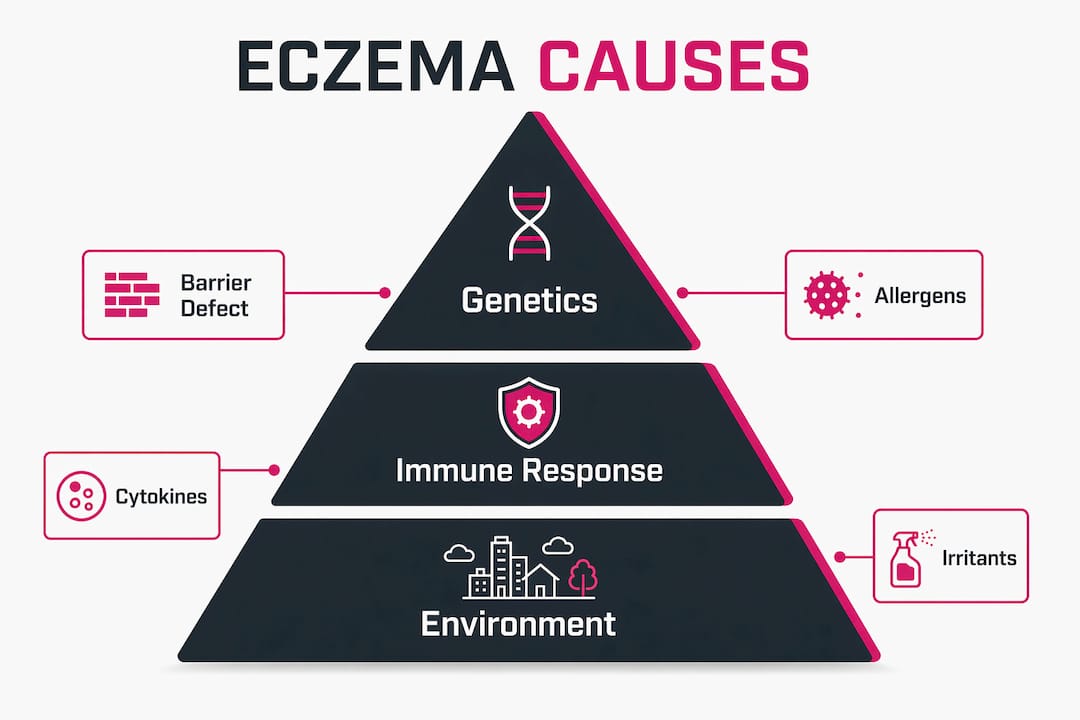
The practical implication is significant. Genetics, immune function, and environment combine uniquely in each person, which means a one-size-fits-all approach leads to unnecessary restrictions and suboptimal outcomes. One patient’s eczema may be driven primarily by a strong filaggrin mutation with minimal immune involvement. Another patient may have a near-normal barrier but an aggressive immune response to specific allergens. Their treatment plans should differ accordingly.
Personalized diagnosis matters because it identifies which of the three drivers is dominant in your case. A dermatologist who evaluates your family history, skin barrier function, immune markers, and specific triggers can build a management plan that addresses your actual disease pattern rather than a generic one.
Key takeaways
Eczema results from a self-reinforcing combination of genetic barrier defects, immune dysregulation, and environmental triggers, and effective management requires addressing all three simultaneously.
| Point | Details |
|---|---|
| Genetics set the foundation | Filaggrin mutations weaken the skin barrier and increase eczema severity and persistence. |
| Immune dysregulation drives inflammation | Elevated IL-4 and IL-13 cytokines amplify itch and further damage the skin barrier. |
| Triggers vary by person | Allergens, irritants, stress, and climate provoke flares differently in each patient. |
| The itch-scratch cycle is self-perpetuating | Breaking it requires simultaneous barrier repair and immune modulation, not one alone. |
| Personalized care outperforms broad rules | Individual trigger identification and targeted treatment produce better outcomes than generic restrictions. |
Why I think most people misunderstand what eczema actually is
After years of working alongside dermatologists and reviewing patient cases, the most common misconception I encounter is that eczema is simply “sensitive skin” or an allergy problem. Patients arrive having already eliminated gluten, dairy, and half their skincare cabinet, often with no improvement, because they were chasing triggers without addressing the underlying barrier and immune dysfunction driving the condition.
The research is clear on this. Eczema is an internal sensitivity disease rooted in structural skin failure and immune misfiring. Triggers matter, but they are the spark, not the fuel. The fuel is a compromised barrier that cannot keep irritants out and an immune system primed to overreact when they get in. Treating only the triggers is like patching a leaking roof from the inside while ignoring the missing shingles.
What gives me genuine optimism is how much the science has advanced. The identification of IL-4 and IL-13 as central drivers has produced a new class of targeted therapies that work for patients who spent years cycling through treatments that never fully controlled their disease. Personalized approaches, including individualized trigger tracking and barrier-focused care, are now the standard recommendation, not an afterthought.
If you have been managing eczema reactively, responding to flares as they come, the most useful shift you can make is to get a proper evaluation of your specific disease drivers. Knowing whether your eczema is primarily barrier-driven, immune-driven, or heavily trigger-dependent changes every decision that follows.
— Krunal
Raodermatology’s approach to eczema diagnosis and care
Identifying your personal eczema drivers is the first step toward real, lasting control of your symptoms.

Raodermatology offers comprehensive evaluations across its New Jersey, New York, and California locations, with over 25 years of experience in medical dermatology. The practice assesses your genetic risk factors, skin barrier function, and immune profile to build a care plan that targets your specific combination of causes. From prescription barrier repair therapies to advanced immune-modulating treatments, Raodermatology’s dermatology services cover the full range of eczema management. Patients also receive guidance on eczema treatment strategies tailored to their triggers, lifestyle, and disease severity.
FAQ
What are the main root causes of eczema?
Eczema results from three overlapping factors: genetic skin-barrier defects, immune system dysregulation, and environmental triggers. No single cause acts alone; all three must be present to produce the condition.
Can diet cause eczema in adults?
Diet can contribute to eczema flares in some adults, but food triggers are less consistent in adults than in children. A dermatologist-guided elimination approach with careful tracking is the most reliable way to identify whether diet plays a role in your case.
What triggers eczema flares most commonly?
The most common triggers include dust mites, pet dander, fragranced soaps, synthetic fabrics, cold dry air, and psychological stress. Triggers vary significantly between patients, which is why personalized tracking produces better results than broad avoidance.
Why does eczema itch so intensely?
Elevated cytokines IL-4 and IL-13 directly stimulate itch receptors in the skin, producing an intense, often involuntary urge to scratch. Scratching then worsens the barrier damage, which deepens the immune response and increases the itch signal further.
How do I know which eczema contributing factors apply to me?
A dermatologist can evaluate your family history, skin barrier integrity, immune markers, and trigger patterns to identify which factors are dominant in your case. This assessment is the foundation of a personalized management plan that avoids unnecessary restrictions.
Recommended
- Eczema: Complete Guide to Symptoms, Types, Causes, and Treatment Options | Rao Dermatology
- Types of Eczema: Symptoms, Causes, and Treatment | Rao Dermatology
- What Is Eczema? Complete Guide to Causes, Symptoms & Effective Treatment Options | Rao Dermatology
- Effective Eczema Treatment and Management: Expert Tips from NYC Dermatologists | Rao Dermatology
Filed under: